Osteoarthritis and rheumatoid arthritis: what’s the difference?
Osteoarthritis (OA) is the most common type of arthritis. It slowly breaks down a joint and most often affects the hands, hips, back and knees. About 33 million U.S. adults have it. OA is common after age 45, but it is not a normal part of aging, and there is a lot you can do to manage it (CDC). Common signs include:
- Pain when you move the joint, and stiffness after rest or first thing in the morning that eases as you move (CDC) (ChoosePT)
- Swelling, especially after using the joint a lot, or a feeling that the joint is loose or unstable (CDC)
- Less motion, and trouble with stairs, chairs or gripping small items (CDC) (ChoosePT)
Risks include past joint injury, extra body weight, family history, older age and being a woman (CDC).
Rheumatoid arthritis (RA) is an autoimmune disease. The immune system attacks the body’s own tissues, which damages joints in the hands, wrists and knees (CDC). It often affects joints on both sides of the body and may start in the small joints of the fingers. Stiffness is often worst in the morning (ChoosePT). Joints may be tender, warm and swollen, and RA can also cause tiredness and fever (CDC).
RA should be diagnosed and treated by a rheumatologist, an arthritis doctor, as early as possible. Medicines called DMARDs can slow the disease and help prevent joint damage (CDC). Exercise and therapy work alongside that medical care, not in place of it (ACR 2022 RA guideline).
Exercise is a treatment, not just advice
Exercise is strongly recommended for osteoarthritis of the knee, hip and hand (ACR/Arthritis Foundation 2019 guideline). An international guideline lists education and a structured exercise program as core care for knee and hip OA, with weight management added for the knee (OARSI 2019 guideline). For rheumatoid arthritis, regular exercise is strongly recommended to improve pain and function (ACR 2022 RA guideline). What the guidelines say:
- Many types work. Walking, strengthening and water exercise can all be part of care for knee and hip OA. No single type is best, so the right plan is one you will keep doing (ACR/Arthritis Foundation 2019 guideline).
- Supervision helps. Exercise programs tend to work better when they are supervised, often by a physical therapist, than when done alone at home (ACR/Arthritis Foundation 2019 guideline).
- Tai chi is strongly recommended for knee and hip OA (ACR/Arthritis Foundation 2019 guideline).
- Strength training with guidance. For RA, guideline experts stress that a physical therapist or other qualified exercise professional should prescribe and supervise strength training to avoid harm (ACR 2022 RA guideline).
Looking for a structured plan? Our Arthritis Exercise Program explains how we build it, step by step.
How physical therapy helps
Your physical therapist examines you, watches the activities that are hard for you and builds an exercise plan around your goals (ChoosePT). We track your progress with simple tests such as the 30-second chair stand and the Timed Up and Go, plus joint questionnaires like the KOOS JR for knees and the HOOS JR for hips. Your plan may include:
- Strength and aerobic exercise taught so you can do it safely, plus a home program to keep you improving after therapy ends (ChoosePT).
- Hands-on (manual) therapy to improve motion in stiff joints (ChoosePT).
- The right support. A cane is strongly recommended when knee or hip OA makes walking painful or unsteady, and a knee brace is strongly recommended when knee OA makes walking hard and you can tolerate wearing one (ACR/Arthritis Foundation 2019 guideline). We help you choose and use them (ChoosePT).
- Balance and fall prevention. People with arthritis are 4 times more likely to fall at least twice and 5 times more likely to be hurt in a fall (ChoosePT). Our No Fall Protocol® fall-risk assessment and HolStep® leveled home exercise program keep balance practice going between visits.
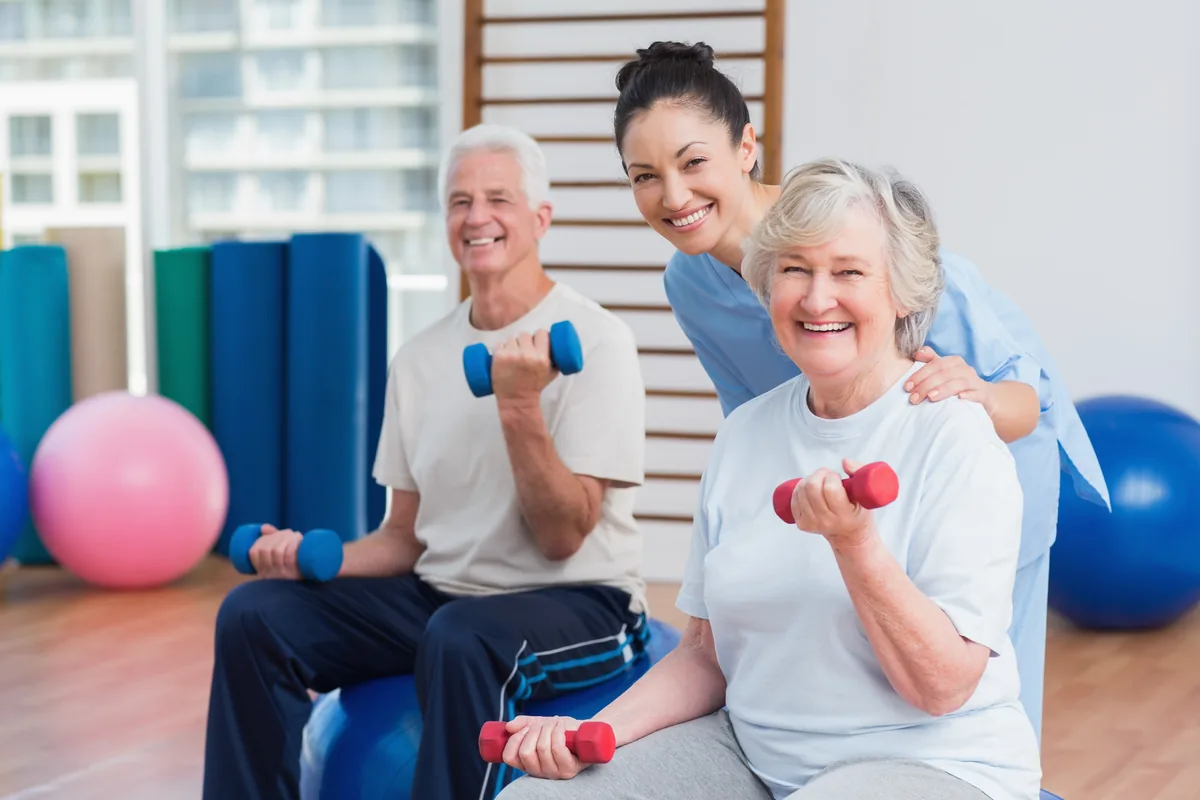
Knee, hip and hand: what to know
- Knee OA. Exercise, such as strengthening and walking, is core care (ACR/Arthritis Foundation 2019 guideline) (OARSI 2019 guideline). See our knee pain page, and if you are headed for surgery, read knee replacement recovery.
- Hip OA. Exercise is core care (OARSI 2019 guideline). The Lower Extremity Functional Scale rates how your hip affects daily life.
- Hand and thumb OA. Exercise is recommended, though it is less studied than for the knee and hip. A splint (orthosis) for arthritis at the base of the thumb is strongly recommended, and splints for other finger joints may help. People thinking about a splint will likely benefit from an occupational therapist’s evaluation (ACR/Arthritis Foundation 2019 guideline).
If therapy alone is not enough, your physical therapist will refer you to an orthopedic specialist to discuss options such as medicine, injections or surgery (ChoosePT).
AlterG® anti-gravity treadmill (Fair Lawn). It takes part of your body weight off your legs so you can practice walking, and later jogging, earlier in recovery, as your therapist and surgeon allow. Ask about it at our Fair Lawn clinic.
How occupational therapy helps
Occupational therapy helps you do the activities of daily living, like dressing and bathing (Medicare.gov). Our occupational therapists focus on your hands and daily tasks. For rheumatoid arthritis, guidelines recommend occupational and physical therapy early and throughout the disease (ACR 2022 RA guideline). Care may include:
- Joint protection. Changing how you do tasks to lower joint stress and pain, such as resting or using other muscle groups (ACR 2022 RA guideline). CDC lists protecting your joints as a way to manage OA (CDC).
- Hand exercises. For RA in the hands, hand exercises may reduce pain and improve function (ACR 2022 RA guideline).
- Splints, braces and compression gloves, chosen and fitted with a therapist’s help so you get the right item and fit (ACR 2022 RA guideline) (ACR/Arthritis Foundation 2019 guideline).
- Pacing and energy saving. Balancing activity and rest to manage fatigue, without long periods of inactivity (ACR 2022 RA guideline).
- Tools that make tasks easier. Built-up or long-handled utensils, button hooks, sock aids and reachers, plus home changes like a raised toilet seat, tub seat and grab bars (ACR 2022 RA guideline).
Occupational therapy is available at our New Jersey clinics. Our Bronx, Bronx Morris Park and Brooklyn clinics offer physical therapy only. Track arm and hand function with our Upper Extremity Functional Index. Read more: What Does an Occupational Therapist Do? and What Is Hand Therapy?
Weight and staying active
For people with knee or hip OA who are overweight, weight loss is strongly recommended. Losing 5% or more of your body weight is linked with real benefit, more loss brings more benefit, and results are better when weight loss is combined with exercise (ACR/Arthritis Foundation 2019 guideline).
Adults with arthritis should aim for at least 150 minutes a week of moderate aerobic activity and muscle-strengthening on at least 2 days a week. Older adults should add balance activities (CDC). Tips from CDC (CDC):
- Short bouts count. Even 5 or 10 minutes at a time adds up.
- Pick joint-friendly activities such as brisk walking, cycling, swimming, dancing and tai chi, with weights or bands that do not cause joint pain.
- Start slow and build gradually. Some pain, stiffness or swelling is normal at first and should get better over time. If it does not, or symptoms are severe, contact your health care provider.
- Get help starting. People with arthritis may benefit from seeing a physical therapist when they begin to be more active.
Try our free fall risk self-check.
When to see your doctor first
Some signs need a doctor’s check before or alongside therapy:
- A joint that is warm, red and swollen. This is not typical of osteoarthritis and may point to another condition (ChoosePT).
- Fever without flu symptoms, or losing 10 pounds or more without trying (MedlinePlus)
- Joint pain that lasts more than several days, or severe joint pain and swelling you can’t explain (MedlinePlus)
- Pain, swelling and stiffness in several joints, which can be signs of rheumatoid arthritis. Early treatment helps prevent joint damage (CDC).
If pain becomes severe after you start exercising, contact your health care provider (CDC).
Can’t get to a clinic?
Our in-home therapy team visits many North Jersey towns, so you can practice on your own stairs and chairs. Read In-Home Physical Therapy: What to Expect.
Insurance and getting started
At our New Jersey clinics, we accept Medicare, Medicare Advantage plans including Clover Health and UnitedHealthcare Medicare Complete, commercial insurance, workers’ compensation, auto/no-fault, VA Community Care and private pay, and we verify your coverage for free before your first visit. See our insurance page for details.
Medicare Part B helps pay for medically necessary outpatient physical therapy and occupational therapy. After the Part B deductible, you usually pay 20% of the Medicare-approved amount, and there is no yearly limit on medically necessary outpatient therapy (Medicare.gov) (Medicare.gov).
In New Jersey you can start physical therapy without a prescription. Within 30 days of your first treatment, we send a written consult to the health care provider you choose. Some insurance plans still require a referral, and Medicare requires your plan of care to be signed by your doctor, nurse practitioner or physician assistant; we coordinate both and tell you what your plan needs. Rules differ in New York, so call us and we will explain what applies to you.
Most New Jersey patients are seen the same day or within 24 hours; our New York City clinics (Bronx, Bronx Morris Park and Brooklyn) and in-home therapy offer same-week appointments.
Related conditions we treat: knee pain, back pain, shoulder pain and neuropathy & nerve pain.
Find a clinic near you
We provide arthritis physical therapy at all 16 open Holsman clinics across Essex, Bergen, Passaic, Hudson and Union counties, the Bronx and Brooklyn, and with in-home therapy across North Jersey. Occupational therapy is offered at our New Jersey clinics. (Our Clifton Route 3 clinic is temporarily closed.)
Related reading: Arthritis Exercise Program in NJ · Carpal Tunnel & Hand Therapy · Why Seniors Fall and How to Prevent It · Physical therapy at Holsman