You wake up at 3 a.m. with your hand asleep, shake it out, and the tingling fades. During the day your fingers go numb while you drive, scroll your phone, or hold a book. Lately you have been dropping things. These are classic signs of carpal tunnel syndrome, and the earlier you deal with them, the more options you have.
This article follows the APTA clinical practice guideline Hand Pain and Sensory Deficits: Carpal Tunnel Syndrome (Erickson et al., Journal of Orthopaedic & Sports Physical Therapy, 2019), from APTA’s Academy of Hand and Upper Extremity Physical Therapy and Academy of Orthopaedic Physical Therapy. Guideline recommendations are paraphrased for patients. Letters in brackets show the guideline’s own grade for each recommendation: [A] strong evidence, [B] moderate, [C] weak, [D] conflicting, [E] theoretical or foundational, [F] expert opinion.
Carpal tunnel syndrome happens when the median nerve, one of the main nerves to the hand, is squeezed as it passes through a narrow tunnel in the wrist (AAOS). For most people it gets worse over time without treatment, and if it goes untreated for too long it can cause permanent numbness and weakness. That is why the American Academy of Orthopaedic Surgeons stresses early diagnosis and treatment (AAOS).
Common Symptoms
- Numbness, tingling, burning or pain in the thumb, index, middle and ring fingers, often waking you at night
- Shock-like feelings into those fingers
- Pain or tingling that travels up the forearm
- Weakness or clumsiness, such as trouble with buttons
- Dropping things
Symptoms usually start slowly and come and go at first. Many people find that shaking out their hands helps (AAOS).
What Raises the Risk?
Most cases come from a mix of factors. Women and older adults are more likely to develop carpal tunnel syndrome. Other risk factors include a family history, repeated hand and wrist motions, holding the wrist bent for long periods, pregnancy, and conditions such as diabetes, rheumatoid arthritis and thyroid imbalance (AAOS). Jobs that involve forceful gripping or vibrating tools are a common source, and heavy computer, phone or tool use can contribute (ChoosePT).
Self-Care to Start Now
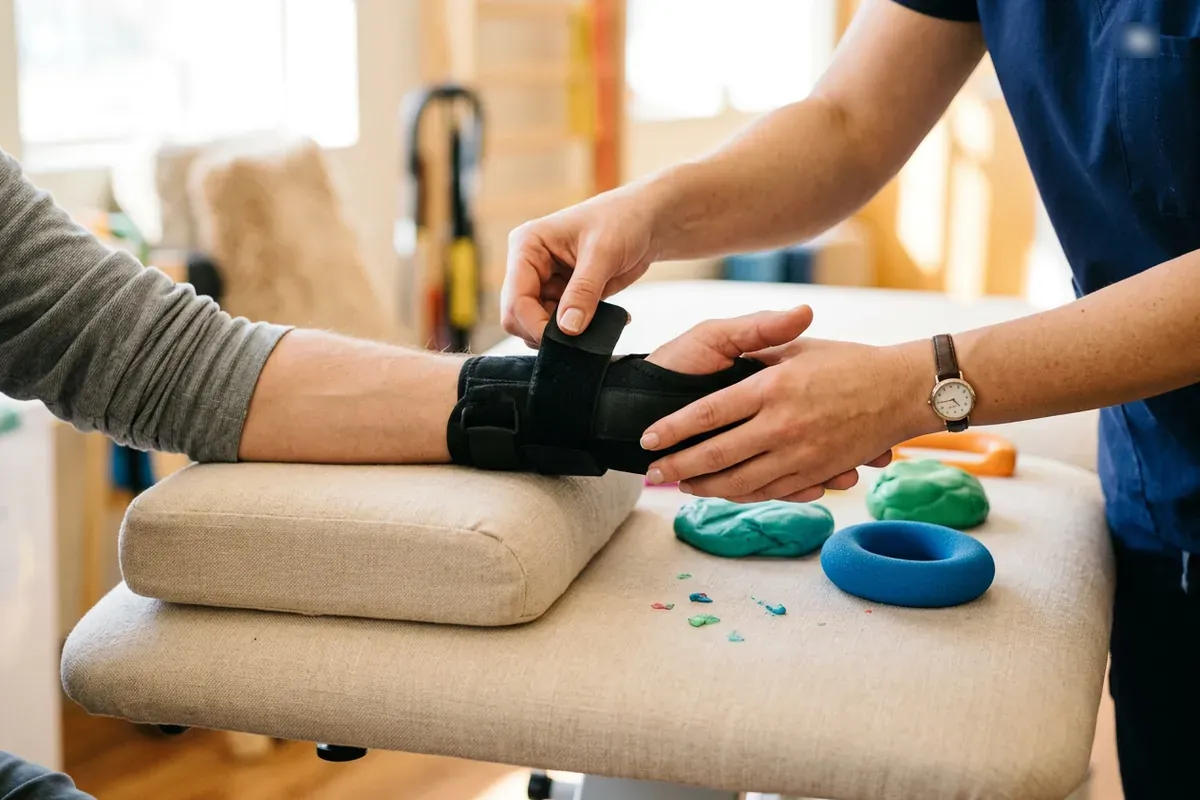
- Keep your wrist straight at night. A wrist splint worn while you sleep keeps the wrist in a neutral position and takes pressure off the nerve (AAOS). The guideline recommends a neutral-position wrist splint worn at night for short-term symptom relief and better function [B] (Carpal Tunnel CPG, JOSPT 2019).
- Avoid long periods with your wrist bent up or down, and take short stretch breaks during repetitive work (ChoosePT).
- Relax your grip. Use less force when typing or gripping, and use larger or padded handles on pens and tools (ChoosePT).
- Check your mouse and keyboard. The guideline says therapists may teach alternatives to heavy mouse use, such as arrow keys, touch screens or switching mouse hands, and may suggest a keyboard that needs less force [C] (Carpal Tunnel CPG, JOSPT 2019).
- Keep your hands warm if you work in a cold space (ChoosePT).
How Hand Therapy Helps
A hand therapist is an occupational therapist or physical therapist with advanced training in the hand and arm. Your evaluation includes your health history, how symptoms affect your work and home life, grip and pinch strength, sensation, and tests such as tapping over the nerve or holding the wrists bent. Your therapist will also check your neck, shoulder and arm, because some people told they have carpal tunnel syndrome turn out to have symptoms coming from another area (ChoosePT).
The guideline recommends questionnaires such as the Boston Carpal Tunnel Questionnaire to measure your symptoms and function [B], and sensation tests such as monofilament testing [A] (Carpal Tunnel CPG, JOSPT 2019). For people choosing nonsurgical care, its treatment recommendations include (Carpal Tunnel CPG, JOSPT 2019):
- A neutral-position wrist splint at night [B]. If night use alone doesn’t control symptoms, wear time may be extended to the daytime, or the splint adjusted or extended to the knuckles [C].
- Education on the condition, risk factors, managing symptoms, and the positions and activities that aggravate them, alongside the splint [C]
- Manual therapy to the neck and arm for short-term relief in mild to moderate cases [C]
- A combined splint and stretching program for mild to moderate cases without thumb-muscle wasting and with normal two-point sensation testing [C]
- A trial of superficial heat for short-term relief [C]
- A splint during pregnancy, with a follow-up check after delivery [C]
The guideline advises against low-level laser and other light therapy [B], iontophoresis [B], magnets [B] and thermal ultrasound [C] for carpal tunnel syndrome (Carpal Tunnel CPG, JOSPT 2019). APTA’s patient guidance adds strengthening once symptoms calm down and changes to your workstation and tools (ChoosePT).
Before or After Surgery
If your symptoms are severe, constant, or not improving, your doctor may recommend carpal tunnel release surgery (AAOS). Hand therapy after surgery can include scar care, gentle nerve and tendon gliding exercises, stretching and strengthening, and help returning to work (ChoosePT). AAOS notes that grip and pinch strength usually return about two to three months after surgery, and that people with significant pain and weakness for more than two months may be referred to a hand therapist (AAOS).
Meet Our Certified Hand Therapists
The Certified Hand Therapist (CHT) credential is voluntary and hard to earn. A CHT is a licensed occupational or physical therapist with at least three years of clinical experience, including 4,000 or more hours in hand therapy, who has passed a comprehensive exam and recertifies every five years (HTCC).
- Brandon Gorny, MSOT, OTR/L, CHT, sees patients at our Rahway clinic. He has been a CHT since 2023 and treats shoulder, elbow, wrist and hand conditions, including rehab after hand surgery.
- Joann Marquez, OT, CHT, sees patients at our Maplewood and South Orange clinics. She has been a CHT since 2007 and brings expertise in splinting, mobilization and wound care.
Learn more about occupational therapy at Holsman. OT is also offered at other locations; call us and we will help you find the right clinic.
Track Your Hand Function
Our free Upper Extremity Functional Index (UEFI) asks how hard everyday arm and hand tasks are for you, and the Pain Disability Index looks at how pain affects daily life. Bring your scores to your first visit. They are not a diagnosis.
When to See a Hand Therapist
- Numbness or tingling in your fingers that wakes you up or keeps coming back
- Symptoms during typing, driving, phone use, or work with tools
- Weakness, clumsiness, or dropping things
- Tingling during pregnancy
- You are scheduled for, or recovering from, carpal tunnel surgery
Work-related hand symptoms may be covered under workers’ compensation; see our post on workers’ compensation physical therapy, and our workplace ergonomics tips.
When to See a Doctor Promptly
This article is general education, not medical advice. See your doctor soon, or get urgent care, for:
- Constant numbness, or shrinking of the muscles at the base of your thumb. Long-standing pressure on the nerve can cause permanent damage (AAOS).
- Hand weakness that is getting worse
- Numbness or tingling after a wrist injury or fall, especially with swelling or deformity
- Numbness in both hands along with trouble walking or balance problems
- Sudden numbness or weakness of the face, arm or leg, or trouble speaking. Call 911.
Book Hand Therapy at Holsman
You can schedule physical therapy, occupational therapy and speech therapy directly. Some insurance plans require a referral for coverage; our staff will verify your benefits for free. See our insurance page for plans we work with. To book with one of our Certified Hand Therapists, call 1-855-465-7626 and ask for Rahway, Maplewood or South Orange, or contact us. See all our New Jersey and New York locations.
Frequently Asked Questions
What are the first signs of carpal tunnel syndrome?
Early signs include numbness, tingling or burning in the thumb, index, middle and ring fingers, often waking you at night, and the urge to shake out your hand. Over time you may notice weakness, clumsiness or dropping things.
Does wearing a wrist splint at night help?
Yes, for many people. Keeping the wrist straight at night takes pressure off the median nerve. The APTA Carpal Tunnel Syndrome clinical practice guideline (JOSPT, 2019) recommends a neutral-position wrist splint worn at night for short-term relief for people choosing nonsurgical care, with a grade of B (moderate evidence).
What is a Certified Hand Therapist (CHT)?
A CHT is a licensed occupational or physical therapist with at least three years of clinical experience, including 4,000 or more hours in hand therapy, who has passed a comprehensive exam from the Hand Therapy Certification Commission and recertifies every five years.
Can carpal tunnel syndrome go away without surgery?
Mild or early carpal tunnel syndrome can often be relieved without surgery using splinting, activity changes and therapy. For most people it worsens over time without treatment, so early evaluation matters. Severe or constant symptoms may need surgery to prevent permanent nerve damage.
Where can I see a Certified Hand Therapist at Holsman?
Brandon Gorny, MSOT, OTR/L, CHT, sees patients at our Rahway clinic, and Joann Marquez, OT, CHT, sees patients at our Maplewood and South Orange clinics. Call 1-855-465-7626 to book.
Do I need a referral for hand therapy?
You can schedule physical therapy, occupational therapy and speech therapy directly. Some insurance plans require a referral for coverage; our staff will verify your benefits for free.
Sources
- Erickson M, Lawrence M, Stegink Jansen CW, et al. Hand Pain and Sensory Deficits: Carpal Tunnel Syndrome. Clinical Practice Guidelines Linked to the International Classification of Functioning, Disability and Health From the Academy of Hand and Upper Extremity Physical Therapy and the Academy of Orthopaedic Physical Therapy of the American Physical Therapy Association. Journal of Orthopaedic & Sports Physical Therapy. 2019;49(5):CPG1–CPG85. doi:10.2519/jospt.2019.0301. Accessed November 2026.
- Carpal Tunnel Syndrome (American Academy of Orthopaedic Surgeons, OrthoInfo). Accessed November 2026.
- Physical Therapy Guide to Carpal Tunnel Syndrome (American Physical Therapy Association, ChoosePT). Accessed November 2026.
- The CHT Credential (Hand Therapy Certification Commission). Accessed November 2026.
This article is for general education and isn't a substitute for an evaluation by a licensed clinician.