What a stroke can change
A stroke happens when a blood vessel in the brain is blocked or bursts, so part of the brain stops getting the blood it needs (ChoosePT). The damage can affect movement, strength, thinking and communication. That can make everyday things harder, like walking, eating, talking, bathing and getting dressed (American Heart Association). Every stroke is different, and recovery can continue for months or even years (American Heart Association).
- Walking and balance. Weakness on one side and poor balance make falls common. Between 36% and 73% of people fall in the first 6 months after leaving the hospital (AHA/ASA 2026 guideline).
- Muscle stiffness (spasticity). About 25% to 46% of people develop tight, stiff muscles after a stroke. It can cause pain and make dressing and washing harder (AHA/ASA 2026 guideline).
- Arm and hand use. Arm weakness is one of the most common problems after a stroke, and it can make it hard to do daily tasks on your own (AHA/ASA 2026 guideline).
- Language and speech. Aphasia makes it hard to find words, understand others, read or write. It does not affect intelligence (ASHA). Dysarthria makes speech slow, slurred or hard to understand (ASHA).
- Swallowing. Stroke is a common cause of swallowing problems (dysphagia), which can lead to coughing at meals, weight loss or pneumonia (ASHA).
- Thinking and mood. Memory and attention can change. Depression is common after a stroke and it can be treated, so tell your doctor if you feel down (American Heart Association).
How physical therapy helps after a stroke
Your first visit is a full evaluation. Your physical therapist asks about your health and goals and watches how you move, stand and walk (ChoosePT). We use standard tests such as the 10-meter walk test for speed, the 6-minute walk test for endurance, the Timed Up and Go and the Berg Balance Scale to measure where you start and track your progress (AHA/ASA 2026 guideline). Your plan may include:
- Walking (gait) training. The best way to walk better is to practice walking: over the ground, on stairs and on different surfaces (ChoosePT). Guidelines support task-specific walking practice with lots of repetition, done at a moderate to high effort (AHA/ASA 2026 guideline). For people 6 months or more after a stroke, walking practice that raises your heart rate has the strongest evidence for walking faster and farther (APTA neurologic guideline). Your therapist sets the level so you work hard but stay safe.
- Balance training and fall prevention. Balance exercises, tai chi and practice doing two things at once (like walking while talking) may lower your risk of falling (AHA/ASA 2026 guideline). See our fall prevention program, the free fall risk self-check and our home fall-hazard checklist.
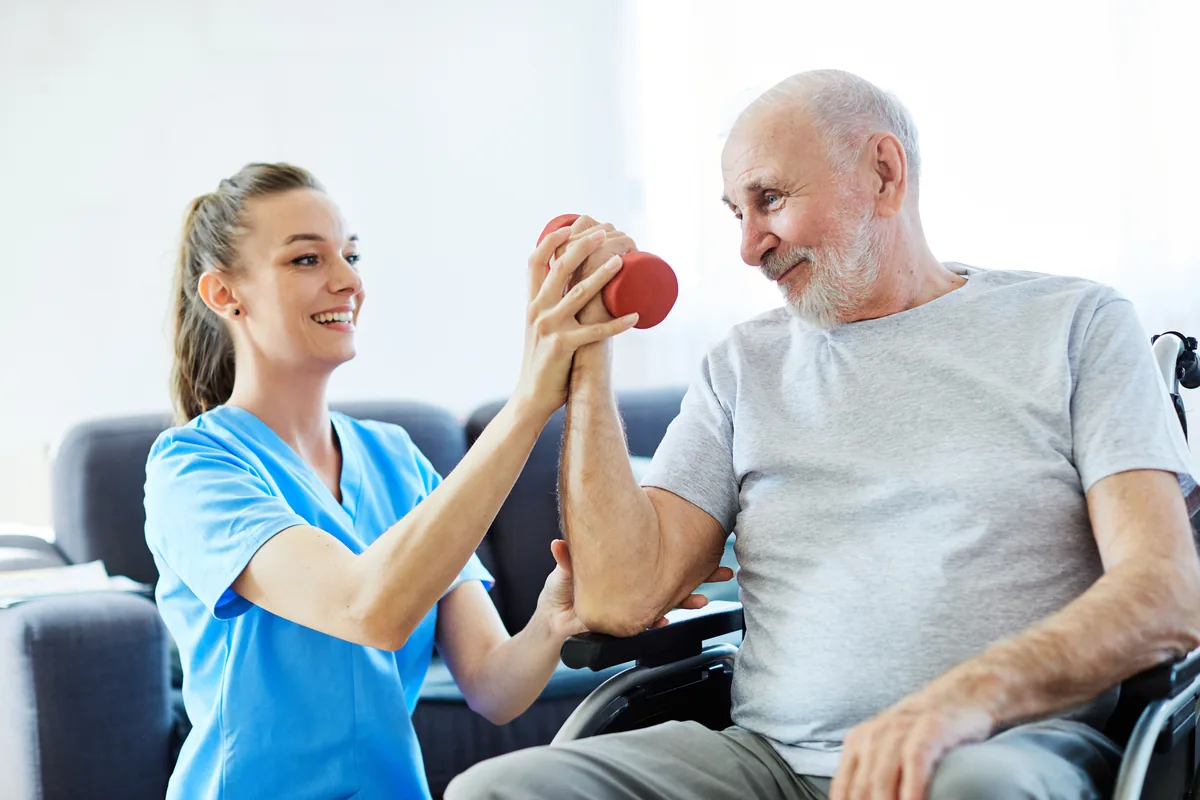
- Strength training. We build strength with exercises based on real tasks, such as standing up from a chair again and again to work the leg muscles (ChoosePT).
- Managing stiffness and spasticity. Good positioning helps ease stiffness, spasms and pain (ChoosePT). We measure muscle tone with the Modified Ashworth Scale and work with your doctor, since care for spasticity can also include injections or medicine (AHA/ASA 2026 guideline). For a weak or painful shoulder, we avoid overhead pulley exercises, which the newest guideline warns can do harm (AHA/ASA 2026 guideline).
- Braces and walking aids. For a dropping foot, an ankle-foot brace (AFO) or electrical stimulation can improve balance, walking speed and getting around. We also help you choose and learn to use a cane, walker or wheelchair (AHA/ASA 2026 guideline) (ChoosePT).
- Family and caregiver training. We teach the people who help you how to assist safely and what to practice at home (ChoosePT) (AHA/ASA 2026 guideline).
Equipment and programs for walking and balance
- Overhead safety harness (all New Jersey clinics and Bronx Morris Park). Lets you practice walking and challenging balance tasks without the risk of falling.
- LiteGait® body-weight support (Lyndhurst and Cedar Grove). Supports part of your body weight so you can practice walking before you can safely walk on your own.
- AlterG® anti-gravity treadmill (Fair Lawn). Takes part of your body weight off your legs so you can practice walking with less load on your joints.
- KinesIQ moving-platform balance training (Cedar Grove, Clifton, Fair Lawn, Lyndhurst and Maplewood). Two moving force platforms with on-screen scenarios to train weight shifting, stepping and recovering your balance.
- No Fall Protocol® and HolStep®. Our fall-risk assessment and leveled home exercise program, so practice continues between visits.
Specialists in neurologic rehab. Our team includes board-certified neurologic clinical specialists (NCS): Dr. Richard Holsman and Dr. Mandakini Desai. Clinicians can also use our Functional Gait Assessment score sheet.
How occupational therapy helps
Occupational therapy helps you do the activities of daily living, like dressing and bathing (Medicare.gov). Our occupational therapists focus on:
- Arm and hand recovery. Practicing real tasks over and over, such as reaching for, grasping and handling objects, is a standard part of stroke rehab (AHA/ASA 2026 guideline). Some people also do constraint-induced movement therapy, where a mitt on the stronger hand makes you use the weaker one (ChoosePT).
- Dressing, bathing and self-care. We work on the tasks you care about most, at your skill level, and teach easier ways to do them (AHA/ASA 2026 guideline).
- Home safety. Good lighting, removing throw rugs, moving cords out of the way and adding handrails in the bathroom and on stairs, plus safe ways to bathe and dress (AHA/ASA 2026 guideline).
- Getting back to your routine. Practicing everyday activities may also help attention and memory, though this research is still early (AHA/ASA 2026 guideline). Read What Does an Occupational Therapist Do?
Occupational therapy is available at our New Jersey clinics.
How speech therapy helps
A speech-language pathologist (SLP) helps with:
- Aphasia. Your SLP tests how you understand, speak, read and write, then works on the goals that matter to you. When words are hard, they teach other ways to communicate, such as gestures, writing, pointing to pictures or using a tablet. Family members can join sessions (ASHA).
- Speech clarity (dysarthria). Speech exercises are the main treatment, and breath-support training can help too (AHA/ASA 2026 guideline) (ASHA).
- Swallowing (dysphagia). Warning signs include coughing or throat clearing during or after meals, a wet or gurgly voice, food sticking or weight loss. An SLP may teach swallowing exercises, safer head and body positions and strategies, or suggest softer foods or thicker drinks (ASHA).
- Thinking skills. Speech therapy can also work on thinking (cognitive) skills (Medicare.gov).
Speech therapy is available at 6 of our New Jersey clinics: Bloomfield, Clifton, Kearny, Lyndhurst, Maplewood and Newark. Our Bronx, Bronx Morris Park and Brooklyn clinics offer physical therapy only.
Outpatient clinic or in-home therapy?
Stroke rehab usually starts in the hospital. Afterward, some people go to an inpatient rehab center or a skilled nursing facility, and others go home with home health care or outpatient therapy (American Heart Association) (AHA/ASA 2026 guideline). Arm and walking recovery often continues for 2 to 6 months, so ongoing therapy in the community matters. Getting to a clinic can be hard, and therapy at home can fill that gap (AHA/ASA 2026 guideline).
- At a clinic: more equipment and room to practice walking and balance. Best if you can travel safely, with or without help.
- At home: practice in your own bathroom, kitchen and stairs, with no travel. Our in-home therapy team visits many North Jersey towns.
Many people start at home and move to a clinic as they get stronger. Read Stroke Recovery: Outpatient vs. In-Home Therapy and Does Medicare cover in-home PT in NJ?
Support for families
Caregivers should be part of rehab planning and training, and they need support too. Regular checks for depression and anxiety matter too: depression is common, can make rehab harder and can be treated (American Heart Association).
When to call 911: B.E. F.A.S.T.
Call 911 right away if you or someone with you has any of these sudden signs (American Stroke Association) (CDC):
- B – Balance: sudden loss of balance or coordination, trouble walking or dizziness
- E – Eyes: sudden blurred or double vision, or loss of sight in one or both eyes
- F – Face: one side of the face droops or is numb; the smile is uneven
- A – Arms: one arm is weak or numb and drifts down when both arms are raised
- S – Speech: slurred, strange or hard-to-understand speech
- T – Time: call 911 immediately
Call 911 even if the signs go away (American Stroke Association). Note the time they started, and don’t drive yourself or let someone drive you to the hospital; an ambulance team can start treatment on the way (CDC).
Insurance and getting started
At our New Jersey clinics, we accept Medicare, Medicare Advantage plans including Clover Health and UnitedHealthcare Medicare Complete, commercial insurance, workers’ compensation, auto/no-fault, VA Community Care and private pay, and we verify your coverage for free before your first visit. See our insurance page for details.
Medicare Part B helps pay for medically necessary outpatient physical therapy, occupational therapy and speech therapy. After the Part B deductible, you usually pay 20% of the Medicare-approved amount, and there is no yearly limit on medically necessary outpatient therapy (Medicare.gov) (Medicare.gov) (Medicare.gov).
In New Jersey you can start physical therapy without a prescription. Within 30 days of your first treatment, we send a written consult to the health care provider you choose. Some insurance plans still require a referral, and Medicare requires your plan of care to be signed by your doctor, nurse practitioner or physician assistant; we coordinate both and tell you what your plan needs. Rules differ in New York, so call us and we will explain what applies to you.
Most New Jersey patients are seen the same day or within 24 hours; our New York City clinics (Bronx, Bronx Morris Park and Brooklyn) and in-home therapy offer same-week appointments.
Related conditions we treat: shoulder pain, neuropathy & nerve pain, back pain and knee pain.
Find a clinic near you
We provide stroke physical therapy at all 16 open Holsman clinics across Essex, Bergen, Passaic, Hudson and Union counties, the Bronx and Brooklyn, and with in-home therapy across North Jersey. (Our Clifton Route 3 clinic is temporarily closed.)
Related reading: Stroke Recovery: Outpatient vs. In-Home Therapy · Why Seniors Fall and How to Prevent It · In-Home Physical Therapy: What to Expect · Physical therapy at Holsman