What’s causing your knee pain?
Knee pain usually comes from one of a few sources. Your therapist’s evaluation pinpoints which one, because the right exercises depend on it.
- Pain around or behind the kneecap (patellofemoral pain). Often worse on stairs, squatting, or after sitting a long time. Common in runners and people who are on their feet all day (AAOS).
- Arthritis. Stiffness in the morning, aching after activity, swelling that comes and goes. Osteoarthritis is the most common type (AAOS); we also treat knee pain from rheumatoid arthritis alongside your rheumatologist’s care. Learn about our arthritis program.
- Meniscus irritation or tears. Pain on the inside or outside of the knee, catching or clicking, trouble with twisting (AAOS).
- Ligament sprains, including ACL and MCL injuries, from a sports injury, a fall or a misstep (ChoosePT).
- Tendon pain (patellar or quadriceps tendinopathy). Pain just below or above the kneecap, often after jumping, running or a sudden increase in activity.
- IT band pain. Pain on the outside of the knee, typical in runners and cyclists (MedlinePlus).
- After surgery, including knee replacement and ACL or meniscus repair. Read our guide to knee replacement recovery week by week.
Pain behind the knee
Pain at the back of the knee often comes from a strained hamstring or calf tendon, a Baker’s cyst (fluid that collects behind the joint, usually alongside arthritis), or a meniscus problem. Sudden calf swelling, warmth and redness with pain behind the knee needs a doctor right away because it can be a blood clot.
Knee pain when bending
Pain when you bend or squat points most often to the kneecap joint, the meniscus or arthritis. Weak hip and thigh muscles make it worse by letting the knee drift inward. Strengthening those muscles and changing how you load the knee can help, and many people feel better within a few weeks.
Knee pain from running
Runner’s knee and IT band pain usually come from training changes (more miles, hills, new shoes) combined with hip weakness. You rarely need to stop running completely; we adjust your training while we work on the cause. See also our sports physical therapy program.
How physical therapy treats knee pain
Your first visit is a full evaluation: how the knee moves, which movements hurt, strength through the hip and leg, and how you walk, squat and climb stairs (ChoosePT). From there your therapist builds a plan that may include:
- Targeted strengthening for the thigh, hip and calf muscles that support the knee.
- Manual therapy, including joint mobilization and soft-tissue massage, as part of your plan of care when it helps.
- Balance and movement retraining so the knee is loaded correctly when you walk, squat and climb.
- Dry needling for tight, painful muscles, available at our Lyndhurst, Caldwell, Fair Lawn and Cedar Grove clinics.
- Shockwave therapy for stubborn tendon pain, available at all open Holsman clinics.
- A home exercise program you can do in 15–20 minutes a day.
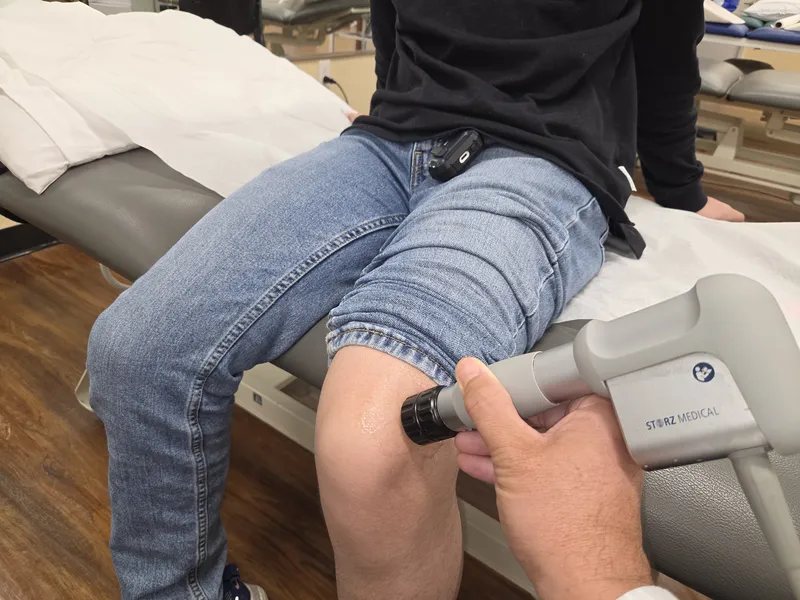
Many people notice improvement within 2–4 weeks. Your therapist will tell you how many visits to expect after your evaluation. If your physical therapist finds something that needs imaging or a doctor’s care, we will tell you and help you get to the right specialist (ChoosePT).
What you can do at home
For knee pain that just started and is not severe, MedlinePlus suggests resting from activities that hurt, using ice (covered with a towel, up to 15 minutes at a time), raising the leg to bring down swelling, and sleeping with a pillow under or between your knees (MedlinePlus). Low-impact activity like cycling or swimming puts less stress on the knee than running (AAOS). If you are not better after about 3 days of home care, or the pain came from an injury, see a provider or a physical therapist (MedlinePlus).
Track your progress
Our free KOOS JR knee score is a short 7-question survey about knee stiffness, pain and daily function. Take it before your first visit and again later to see change over time. It is not a diagnosis. For clinicians and students, we also publish normal knee range of motion by age and sex and a guide to knee special tests.
When to see a doctor first
See a doctor or go to urgent care before starting therapy if you:
- can’t put weight on the leg after an injury (MedlinePlus)
- heard a pop and the knee swelled quickly
- have a knee that locks and won’t straighten (MedlinePlus)
- have fever, redness or a hot, swollen knee (MedlinePlus)
- have sudden calf swelling or pain behind the knee with warmth (MedlinePlus)
- after a knee replacement: have sudden shortness of breath or chest pain (call 911), new or increasing calf pain or swelling, or a fever over 100°F, chills, drainage or increasing redness at the incision (AAOS)
We can help coordinate with your doctor if any of these apply.
Insurance and getting started
We accept Medicare, most commercial plans, workers’ compensation, auto/no-fault and VA Community Care, and we verify your coverage for free before your first visit. See our insurance page for details.
In New Jersey you can start physical therapy without a prescription. Within 30 days of your first treatment, we send a written consult to the healthcare provider you choose. Some insurance plans still require a referral, and Medicare requires your doctor or nonphysician practitioner (NPP) to sign your plan of care; we coordinate both and tell you what your plan needs. Rules differ in New York, so call us and we will explain what applies to you.
Most New Jersey patients are seen the same day or within 24 hours; our New York City clinics (Bronx, Bronx Morris Park and Brooklyn) and in-home therapy offer same-week appointments.
Find a clinic near you
We treat knee pain at all 16 open Holsman clinics across Essex, Bergen, Passaic, Hudson and Union counties, the Bronx and Brooklyn, and with in-home therapy across North Jersey. (Our Clifton Route 3 clinic is temporarily closed.)
Related reading: Knee Replacement Recovery: PT Week by Week · Physical therapy at Holsman · Sports physical therapy · Dry needling · Shockwave therapy