Common causes of hip pain
The hip is a ball-and-socket joint where the top of the thighbone fits into the pelvis (AAOS). Common causes of pain include:
- Hip osteoarthritis. The smooth cartilage in the joint slowly wears away. It is most common after age 50 (AAOS). Pain is usually in the groin or thigh. Stiffness is often worse in the morning or after sitting, and putting on socks or getting up from a chair can get hard (AAOS) (ChoosePT).
- Outer hip pain (bursitis or greater trochanteric pain syndrome). Pain sits at the point of the hip and often spreads down the outside of the thigh. It is usually worse when lying on that side, getting up from a chair or climbing stairs (AAOS). It is more common in women and older adults (MedlinePlus).
- Hip impingement (FAI) and labral tears. In impingement, extra bone on the ball or socket makes the bones rub. Over time this can tear the labrum, the ring of cartilage around the socket, and lead to arthritis (AAOS). A labral tear can cause a deep groin ache and painful clicking or catching (ChoosePT).
- Hip fracture. A break in the top of the thighbone. More than 300,000 Americans break a hip each year, mostly adults 65 and older who fall (AAOS).
Get emergency care if a fall leaves you unable to stand or put weight on your leg, or if the leg looks shorter or turned outward. These are common signs of a hip fracture (AAOS).
How physical therapy helps hip arthritis and hip pain
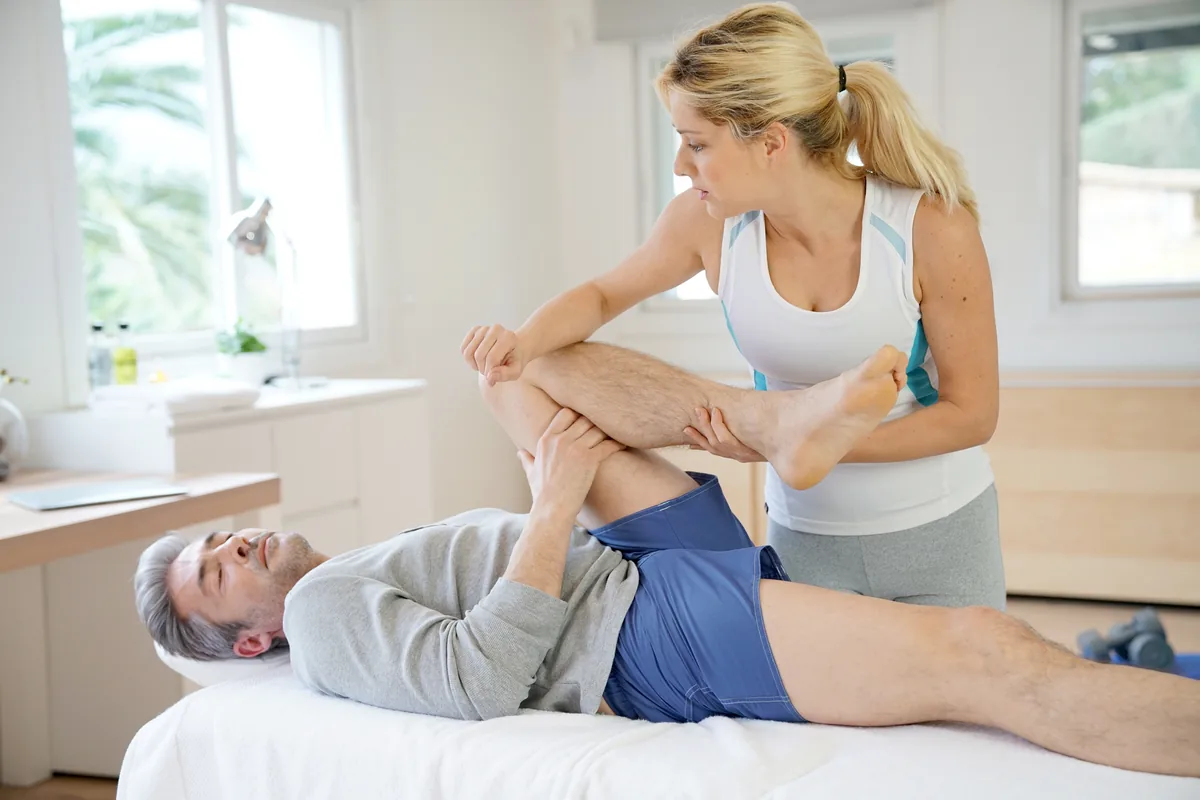
Your first visit is a full evaluation. Your physical therapist asks about your pain and goals, checks your hip motion and strength, and watches you walk, balance, climb stairs and stand up from a chair (ChoosePT). Guidelines recommend tracking progress with tests like the 30-second chair stand, Timed Up and Go and 6-minute walk test, plus a hip questionnaire (APTA hip arthritis guideline 2017). Try our free HOOS, JR. hip score. Your plan may include:
- Exercise made for you. The 2025 guideline strongly recommends an individualized program to improve motion, strength, function and pain, which can include water exercise (APTA hip arthritis guideline 2025).
- Hands-on (manual) therapy. Joint and soft-tissue mobilization can increase motion, decrease pain and improve function in mild to moderate hip arthritis (APTA hip arthritis guideline 2025).
- Walking, balance and education. Gait and balance training, using a cane or walker the right way, ways to take load off the joint, and support for weight loss when it would help (APTA hip arthritis guideline 2025).
- Help for outer hip pain. Stretching, hip strengthening, a home program and a gradual return to activity (ChoosePT). A pillow between your knees can ease pain at night (MedlinePlus).
- Help for impingement or a labral tear. Exercises for hip motion and strength can take stress off the labrum and cartilage (AAOS). Some people do well without surgery; after hip arthroscopy, therapy usually lasts several months (ChoosePT).
- Dry needling for painful trigger points in the hip muscles, as an option at our Lyndhurst, Caldwell, Fair Lawn and Cedar Grove clinics. The 2025 guideline supports it for short-term gains in pain, motion and function in hip arthritis (APTA hip arthritis guideline 2025). Dry needling is often not covered by insurance, and Medicare does not pay for it.
If you are not improving, your therapist should change the plan or refer you to the right clinician (APTA hip arthritis guideline 2017). See physical therapy as a first step for arthritis.
Rehab after a hip fracture
Most hip fractures need surgery, and most people start therapy the next day, because moving early helps prevent blood clots, pneumonia and bed sores. Physical and occupational therapists teach exercises, how much weight to put on the leg, and how to bathe and dress (AAOS).
After the hospital, some people go to a rehab facility. Others go home with in-home physical therapy until they are strong enough to travel to a clinic (AAOS). The APTA hip fracture guideline calls for:
- A prompt evaluation. A physical therapist should see you within 72 hours of moving from the hospital to a facility or home care (APTA hip fracture guideline).
- Structured exercise. Progressive, high-intensity strength training plus balance, weight-bearing and mobility training (APTA hip fracture guideline).
- Tracking progress and fall risk with the Five Times Sit-to-Stand and the Falls Efficacy Scale (APTA hip fracture guideline).
- More therapy when needed if strength, balance or function problems remain 8 to 16 weeks after the fracture (APTA hip fracture guideline).
- Care for people with dementia. People with mild to moderate dementia should get rehab too, using the same kinds of treatment (APTA hip fracture guideline).
- Bone health: a check for osteoporosis to help prevent the next fracture (APTA hip fracture guideline).
Recovery can be hard. Weakness and fear of falling can last for months, and many people do not get back to how they moved before (APTA hip fracture guideline).
Rehab after a hip replacement
In a total hip replacement, the surgeon replaces both the ball and the socket. A partial replacement (hemiarthroplasty) replaces only the ball and is often used for hip fractures in older adults (ChoosePT) (AAOS).
- Before surgery. A physical therapist can teach you exercises, walker use and what precautions to expect, and help you set up your home (ChoosePT).
- Going home. Many people stay 1 to 2 days or go home the same day, once they can get out of bed, walk with a walker or crutches and manage a few stairs (AAOS).
- Precautions as your surgeon directs. Depending on how the surgery was done, you may need to avoid certain positions for the first several weeks, such as bending the hip past 90 degrees or crossing your legs. Precautions and how much weight you may put on the leg differ from surgeon to surgeon (AAOS) (AAOS). We follow your surgeon’s orders.
- Getting stronger. A walking program, stairs and hip exercises restore movement and strength. Most people return to light daily activities in 3 to 6 weeks (AAOS). Keep doing your exercises for at least 2 months after surgery (AAOS).
- Back to what you enjoy. Walking, swimming, golf and biking are realistic goals; most surgeons advise against high-impact sports like running (AAOS).
After hip surgery, call your surgeon right away if you notice (AAOS):
- Signs of infection: fever over 100°F, chills, more redness or swelling of the wound, drainage, or hip pain that keeps getting worse
- Signs of a blood clot: calf or leg pain not related to the incision, tenderness or redness of the calf, or new swelling of the thigh, calf, ankle or foot
Sudden shortness of breath or sudden chest pain can mean a clot has traveled to the lungs, which can be life-threatening. Get emergency help right away (AAOS).
AlterG® anti-gravity treadmill (Fair Lawn). It takes part of your body weight off your legs so you can practice walking, and later jogging, earlier in recovery, as your therapist and surgeon allow. Ask about it at our Fair Lawn clinic.
How occupational therapy helps
Occupational therapy helps you do activities of daily living, like dressing and bathing (Medicare.gov). After hip surgery, our occupational therapists teach safe ways to dress and bathe, and tools that keep you from bending too far, such as a reacher, sock aid, shower bench and raised toilet seat (AAOS). Read What Does an Occupational Therapist Do?
Occupational therapy is available at our New Jersey clinics.
Preventing falls and the next fracture
Falls cause most hip fractures: about 300,000 hip fracture hospitalizations each year come from falls in older adults, and many people can’t live on their own afterward (CDC). The CDC recommends strength and balance exercise such as tai chi, a medicine review, eye exams, osteoporosis screening and a safer home (CDC).
Our fall prevention program includes the No Fall Protocol® and HolStep® balance programs. All our New Jersey clinics and Bronx Morris Park have an overhead safety harness; Lyndhurst and Cedar Grove offer LiteGait® body-weight support, and Cedar Grove, Clifton, Fair Lawn, Lyndhurst and Maplewood offer KinesIQ moving-platform balance training. Read why seniors fall or try our free fall risk self-check and home fall-hazard checklist.
Can’t get to a clinic yet? Our in-home therapy team visits many North Jersey towns, and many people move to a clinic as they get stronger. Read In-Home Physical Therapy: What to Expect and Does Medicare cover in-home PT in NJ?
Insurance and getting started
At our New Jersey clinics, we accept Medicare, Medicare Advantage plans including Clover Health and UnitedHealthcare Medicare Complete, commercial insurance, workers’ compensation, auto/no-fault, VA Community Care and private pay, and we verify your coverage for free before your first visit. See our insurance page for details.
Medicare Part B helps pay for medically necessary outpatient physical therapy and occupational therapy. After the Part B deductible, you usually pay 20% of the Medicare-approved amount, and there is no yearly limit on medically necessary outpatient therapy (Medicare.gov) (Medicare.gov).
In New Jersey you can start physical therapy without a prescription. Within 30 days of your first treatment, we send a written consult to the health care provider you choose. Some insurance plans still require a referral, and Medicare requires your plan of care to be signed by your doctor, nurse practitioner or physician assistant; we coordinate both and tell you what your plan needs. Rules differ in New York, so call us and we will explain what applies to you.
Most New Jersey patients are seen the same day or within 24 hours; our New York City clinics (Bronx, Bronx Morris Park and Brooklyn) and in-home therapy offer same-week appointments.
Related conditions we treat: knee pain, back pain, shoulder pain, neuropathy & nerve pain and stroke rehabilitation.
Find a clinic near you
We provide hip physical therapy at all 16 open Holsman clinics across Essex, Bergen, Passaic, Hudson and Union counties, the Bronx and Brooklyn, and with in-home therapy across North Jersey. (Our Clifton Route 3 clinic is temporarily closed.)