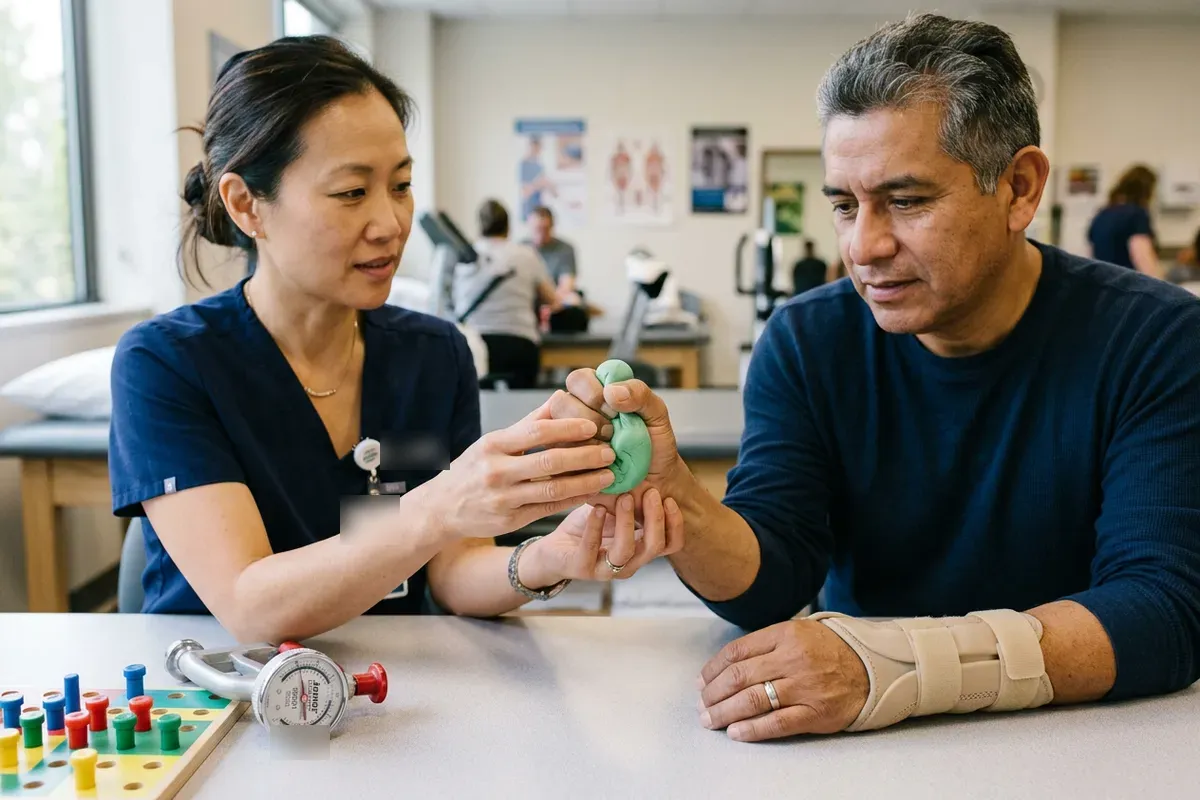
From carpal tunnel and trigger finger to recovery after a wrist fracture, hand therapy helps you get back the grip, motion and fine control you use every day. Here is what hand therapy treats, what to expect, and what makes a Certified Hand Therapist different.
Your hands do thousands of small jobs a day, so even a minor injury can make buttoning a shirt, typing or opening a jar frustrating. Hand therapy is specialized rehabilitation for the hand and arm.
What Is Hand Therapy?
The Hand Therapy Certification Commission (HTCC) defines hand therapy as the rehabilitation of the upper limb, which includes the hand, wrist, elbow and shoulder girdle. It blends occupational therapy and physical therapy theory and practice, and hand therapists are occupational therapists or physical therapists (HTCC). The American Society of Hand Therapists adds that a hand therapist works closely with your physician, treating people after surgery, with non-operative care, and with prevention (ASHT).
So when people search for “hand physical therapy” or “hand occupational therapy,” they are looking for the same specialty: a licensed therapist with advanced skills in the hand and arm.
What Hand Therapy Treats
Hand therapists treat problems that affect the hand and upper limb from trauma, disease, or congenital or acquired deformity (HTCC). Common examples:
- Carpal tunnel syndrome: numbness and tingling in the thumb and fingers from pressure on the median nerve. Wrist splinting and activity changes are common first treatments (AAOS OrthoInfo). See our full guide to carpal tunnel and hand therapy.
- Trigger finger or thumb: a finger that catches or locks. First-line care includes rest from repetitive gripping, a night splint that keeps the finger straight, and gentle stretching. After surgery, your doctor may send you to a hand therapist if stiffness, swelling or pain don’t improve (AAOS OrthoInfo).
- De Quervain’s tenosynovitis: pain along the thumb side of the wrist, often in new parents and people who do repetitive lifting. A removable splint that keeps the wrist straight and the thumb still may ease pain (AAOS OrthoInfo).
- Fractures and surgery: wrist and finger fractures, tendon and nerve repairs, and joint replacements often need guided therapy to restore motion and strength safely.
- Arthritis: joint protection, splints and exercise to keep hands working.
- Elbow and shoulder problems: such as tennis elbow, since hand therapy covers the whole upper limb (HTCC).
What Happens in Hand Therapy
Your first visit includes a history and an exam of motion, strength (often with a grip-strength gauge), sensation, swelling and how you use your hand for daily tasks. Treatment is then matched to your diagnosis and, after surgery, to your surgeon’s protocol. According to the HTCC scope of practice, hand therapy can include custom orthoses (splints), sensory re-education and desensitization, therapeutic activities and exercise, work conditioning and return-to-work programs, and wound care (HTCC). You will also leave with a home program, because short, frequent practice between visits matters.
What Is a Certified Hand Therapist (CHT)?
Any licensed OT or PT can treat hand problems, but the Certified Hand Therapist credential shows advanced, tested expertise. HTCC describes it as voluntary and difficult to attain. A CHT has:
- At least three years of clinical experience, including 4,000 hours or more of direct practice in hand therapy
- A passing score on a comprehensive exam of advanced clinical skills and theory in upper-limb rehabilitation
- Recertification every five years to show continued professional development
Those requirements come from the HTCC itself (HTCC). You can look up a therapist’s certification on the HTCC website.
Certified Hand Therapists at Holsman
Two of our occupational therapists hold the CHT credential:
- Joann Marquez, OT, CHT, Certified Hand Therapist since 2007, sees patients at our Maplewood and South Orange clinics. Her expertise includes custom splinting, joint and soft-tissue mobilization, and wound care.
- Brandon Gorny, MSOT, OTR/L, CHT, Certified Hand Therapist since 2023, sees patients at our Rahway clinic. He treats shoulder, elbow, wrist and hand conditions, including care after hand surgery.
Our other physical and occupational therapists also treat hand, wrist and elbow problems at clinics across New Jersey and New York City. When you call, tell us your diagnosis and we’ll match you with the right therapist and location.
See a Doctor or Urgent Care First If
Hand therapy is for recovery. Some hand problems need a doctor right away.
- A finger, hand or wrist looks bent or deformed after an injury, or you cannot move it
- A finger turns pale, blue or cold, or you have new numbness after an injury
- A cut is deep or won’t stop bleeding, or a wound or joint is red, hot, swollen or draining, especially with a fever
- Call 911 for sudden numbness or weakness of the face, arm or leg, especially on one side, or sudden trouble speaking. These can be signs of a stroke (NINDS).
Getting Started
You can schedule physical therapy, occupational therapy and speech therapy directly. Some insurance plans require a referral for coverage; our staff will verify your benefits for free. If you’ve had hand surgery, bring your surgeon’s protocol or therapy order. Call 1-855-465-7626 or request an appointment with the form on this page, and learn more on our occupational therapy page.
Frequently Asked Questions
What is hand therapy?
Hand therapy is rehabilitation of the upper limb, including the hand, wrist, elbow and shoulder girdle. It is provided by occupational therapists and physical therapists with advanced training, and it can include splints, exercise, sensory re-education, wound care and return-to-work programs.
What is a Certified Hand Therapist (CHT)?
A Certified Hand Therapist is an occupational or physical therapist who has at least three years of clinical experience, including 4,000 or more hours of direct hand therapy practice, has passed the Hand Therapy Certification Commission exam, and recertifies every five years.
Is hand therapy physical therapy or occupational therapy?
Both. Hand therapy blends occupational therapy and physical therapy, and hand therapists can be either OTs or PTs.
What conditions does a hand therapist treat?
Common conditions include carpal tunnel syndrome, trigger finger, De Quervain's tenosynovitis, wrist and finger fractures, tendon and nerve injuries, arthritis, and recovery after hand, wrist or elbow surgery.
Where can I see a Certified Hand Therapist at Holsman?
Joann Marquez, OT, CHT, sees patients at our Maplewood and South Orange clinics, and Brandon Gorny, MSOT, OTR/L, CHT, sees patients at our Rahway clinic. Call 1-855-465-7626 to schedule.
Sources
- Hand Therapy Certification Commission (HTCC). Definition of Hand Therapy and Scope of Practice of Certified Hand Therapists. 2026. Accessed November 2026.
- Hand Therapy Certification Commission (HTCC). The CHT Credential: Certified Hand Therapist—The Recognized Specialist in Hand Therapy. Accessed November 2026.
- American Society of Hand Therapists (ASHT). Why See a Hand Therapist. Accessed November 2026.
- American Academy of Orthopaedic Surgeons, OrthoInfo. Carpal Tunnel Syndrome. Accessed November 2026.
- American Academy of Orthopaedic Surgeons, OrthoInfo. Trigger Finger – Trigger Thumb. Accessed November 2026.
- American Academy of Orthopaedic Surgeons, OrthoInfo. De Quervain’s Tenosynovitis. Accessed November 2026.
- National Institute of Neurological Disorders and Stroke (NIH). Stroke: Signs and Symptoms. Accessed November 2026.
This article is for general education and isn't a substitute for an evaluation by a licensed clinician.