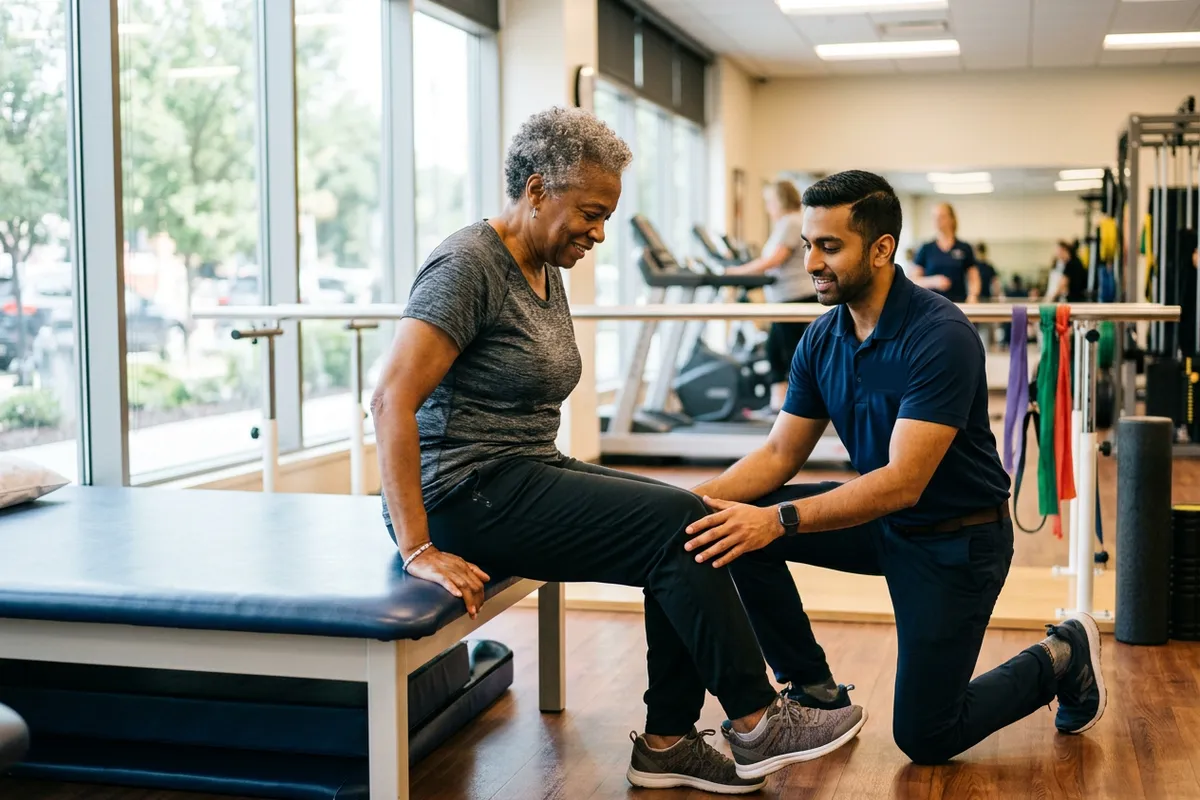
Stiff knees, an aching hip, or a sore thumb joint do not have to mean pills, giving things up, or waiting for surgery. Major guidelines put exercise and therapy at the center of osteoarthritis care. Here is what that looks like in practice.
Many people are told their joint pain is "just arthritis" and that it comes with age. Some quietly give up walks or gardening. Others assume surgery is the only real fix.
The evidence points another way. For osteoarthritis (OA) of the knee, hip, and hand, the most common form of arthritis, exercise is one of the most strongly recommended treatments there is. A physical or occupational therapist can help you do it safely and in a way that fits your life. This guide explains why therapy belongs at the start of your plan, not the end.
How Common Is Arthritis?
Very common. About 53.2 million U.S. adults, or roughly 1 in 5, report that a health professional has diagnosed them with arthritis (CDC, 2023). Nearly half of adults with arthritis are 65 or older. CDC also notes that arthritis is a leading cause of activity limits, disability, and chronic pain.
Osteoarthritis affects the whole joint: the cartilage, the bone underneath, and the lining of the joint. That leads to pain, stiffness, swelling, and trouble with everyday tasks (ACR/Arthritis Foundation, 2019).
What the Guidelines Say
In 2019, the American College of Rheumatology (ACR) and the Arthritis Foundation published a joint guideline for OA of the hand, hip, and knee. Its panel included rheumatologists, physical and occupational therapists, and patients. Among its key points (ACR/Arthritis Foundation, 2019):
- Exercise is strongly recommended for knee, hip, and hand OA. No single type of exercise was proven best, so the right program is one you will actually do.
- Supervised exercise tends to work better than exercising alone at home, often with a physical therapist leading it.
- Weight loss is strongly recommended for knee and hip OA in people who are overweight. Losing 5% or more of body weight was linked with real benefit, and results were better when combined with exercise.
- A cane, a knee brace, and tai chi are strongly recommended when they fit the situation. Balance exercises are conditionally recommended.
- Hand orthoses (splints) are strongly recommended for arthritis at the base of the thumb.
The panel also wrote that most people with OA are likely to benefit from physical therapy and/or occupational therapy at various points in their condition.
The American Geriatrics Society (AGS) reached a similar conclusion for older adults. Its consensus recommendations call physical activity an integral part of OA care and note that well-designed trials showed regular moderate exercise did not worsen OA pain or speed up joint damage (AGS, 2001).
How big is the benefit?
Honest answer: helpful, but not magic. A 2024 Cochrane review of 139 trials and more than 12,000 people with knee OA found that exercise probably improves pain, physical function, and quality of life in the short term. The average improvement was modest, and many trials were small or lower quality (Cochrane, 2024). That is why a good plan pairs exercise with other proven steps, such as weight management, the right supports, and pacing, rather than relying on any one thing.
Why "Rest It" Often Backfires
When a joint hurts, resting it feels right. But long stretches of inactivity weaken the muscles that support the joint and make stiffness worse. Then everyday movement hurts more, and the cycle continues.
The AGS lists muscle weakness and inactivity as risk factors for OA that can be changed. Its review highlights weak thigh (quadriceps) muscles in knee OA, and notes that strength and aerobic programs reduced pain and improved mobility (AGS, 2001). Strong muscles help steady and support the joint during daily movement.
What a Physical Therapy Plan Looks Like
Your first physical therapy visit starts with an evaluation: how you walk, climb stairs, and get up from a chair, plus strength, joint motion, balance, and what matters most to you. From there, your plan may include:
- Strengthening for the hips, thighs, and core, starting gently and building gradually.
- Range-of-motion and flexibility work to ease stiffness.
- Walking or cycling to build endurance without pounding the joints.
- Balance training, especially if you have had a fall or feel unsteady.
- Practical coaching on pacing, flare-ups, stairs, and getting in and out of the car.
- Help choosing a cane or brace, and learning to use it correctly.
- A home program you can keep doing after therapy ends.
Active treatment is the core. The ACR/Arthritis Foundation guideline actually recommends against some passive treatments for knee and hip OA, such as TENS (electrical nerve stimulation), and found little added benefit from manual therapy on top of exercise (ACR/Arthritis Foundation, 2019).
Tools that can help you get moving
At our Fair Lawn adult clinic, we have an AlterG anti-gravity treadmill. It lets you walk while carrying only part of your body weight, which can make it easier to practice walking when knee or hip pain is holding you back. Your therapist can tell you whether it fits your plan.
You may also hear about shockwave therapy, which is available at all of our adult clinics. It is mainly used for stubborn tendon problems, and research on using it for arthritic joints themselves is still limited. We do not treat it as a replacement for exercise. If tendon pain near an arthritic knee or hip is part of the picture, ask your therapist whether it is worth considering.
Hand Arthritis: Where Occupational Therapy Helps
OA often shows up in the finger joints and at the base of the thumb. That can make jars, keys, buttons, and phones frustrating. Occupational therapy focuses on keeping you independent with those daily tasks. An occupational therapist can help with:
- Splints (orthoses) for the thumb or fingers. The ACR guideline notes that people considering these will likely benefit from an occupational therapist's evaluation.
- Joint protection: ways to grip, lift, and carry that spread the load and ease strain on small joints.
- Adaptive tools such as jar openers, built-up handles, and easier-grip utensils.
- Hand exercises and heat, such as paraffin, which the guideline conditionally recommends for hand OA.
How Much Activity Should You Aim For?
CDC recommends that adults, including those with arthritis, aim for at least 150 minutes a week of moderate activity, plus muscle-strengthening at least 2 days a week. Older adults should add balance activities. Sessions of just 5 or 10 minutes count (CDC, 2024).
Joint-friendly choices include brisk walking, cycling, light gardening, dancing, tai chi, and swimming. CDC says some pain, stiffness, or swelling is normal when you start something new, and it also notes that people with arthritis may benefit from seeing a physical therapist when beginning physical activity. The AGS adds a useful warning sign: joint pain that lasts more than 1 to 2 hours after exercise, or new swelling, suggests you did too much (AGS, 2001).
What If You Are Heading Toward Surgery?
Therapy is not only for people trying to avoid surgery. If you and your surgeon decide a joint replacement is right for you, getting stronger beforehand can make the road back easier. Read more about recovering from knee replacement with physical therapy.
When to see a doctor right away
Joint pain is not always osteoarthritis. Get medical care promptly if you have:
- A hot, red, very swollen joint, especially with fever or chills
- Sudden severe pain or inability to bear weight, especially after a fall
- Calf pain, warmth, or swelling, particularly after surgery or a long period of sitting
- Several swollen joints with morning stiffness that lasts a long time, which can point to inflammatory arthritis
- Unexplained weight loss, night pain that does not ease, or numbness and weakness
Getting Started with Holsman
You can schedule physical therapy, occupational therapy and speech therapy directly. Some insurance plans require a referral for coverage; our staff will verify your benefits. Learn more on our insurance page.
We have 17 clinics across New Jersey and New York, including Fair Lawn, Lyndhurst, Clifton, and the Bronx. If getting to a clinic is hard because of pain or mobility, ask about in-home therapy. Call 1-855-465-7626 or contact us.
Frequently Asked Questions
Will exercise make my arthritis worse?
For most people with osteoarthritis, no. Guidelines strongly recommend exercise, and trials reviewed by the American Geriatrics Society found regular moderate exercise did not worsen OA pain or speed up joint damage.
Do I need X-rays or an MRI before starting physical therapy?
Not always. Your therapist will examine you and will refer you to a physician if anything suggests you need imaging or another type of care.
What is the best exercise for knee or hip arthritis?
Research has not found one best type. Walking, strengthening, balance work, cycling, and tai chi can all help. The best exercise is one that suits your joints, your goals, and your schedule, and that you will keep doing.
Can occupational therapy help arthritis in my hands?
Yes. An occupational therapist can fit splints, teach joint protection, suggest adaptive tools, and give you hand exercises so daily tasks like opening jars and buttoning shirts get easier.
Can I get therapy for arthritis at home?
Yes. Holsman offers in-home therapy for people who have trouble getting to a clinic. Our staff can explain options and check your insurance benefits.
Sources
- Kolasinski SL, Neogi T, Hochberg MC, et al. 2019 American College of Rheumatology/Arthritis Foundation Guideline for the Management of Osteoarthritis of the Hand, Hip, and Knee. Arthritis Care & Research. 2020;72(2):149-162. doi:10.1002/acr.24131
- Fallon EA, Boring MA, Foster AL, et al. Prevalence of Diagnosed Arthritis, United States, 2019-2021. MMWR. 2023;72:1101-1107. Centers for Disease Control and Prevention. cdc.gov/mmwr/volumes/72/wr/mm7241a1.htm
- Centers for Disease Control and Prevention. About Physical Activity and Arthritis. 2024. cdc.gov/arthritis/prevention
- American Geriatrics Society Panel on Exercise and Osteoarthritis. Exercise Prescription for Older Adults With Osteoarthritis Pain: Consensus Practice Recommendations. Journal of the American Geriatrics Society. 2001;49(6):808-823. doi:10.1046/j.1532-5415.2001.00496.x
- Lawford BJ, Hall M, Hinman RS, et al. Exercise for osteoarthritis of the knee. Cochrane Database of Systematic Reviews. 2024. doi:10.1002/14651858.CD004376.pub4
This article is for general education and isn't a substitute for an evaluation by a licensed clinician.