Late walking, tiptoe walking, a baby who always tilts the head, a child who trips more than friends do: pediatric physical therapy helps with all of these. Here is what pediatric PT treats, the signs that it’s worth an evaluation, and what to expect at our Children’s Therapy Center in Fair Lawn.
Every child develops at their own pace, so it can be hard to know when a late walker, a head tilt or tiptoe walking is something to check. Pediatric physical therapy helps babies, children and teens build the strength, balance and coordination they need to move, play and keep up with friends.
What Pediatric Physical Therapy Treats
Pediatric PT focuses on gross motor skills: rolling, sitting, crawling, walking, running, jumping, climbing stairs and balance. Common reasons children see a pediatric physical therapist include:
Missed motor milestones
The CDC defines developmental milestones as things most children (75% or more) can do by a certain age. By 18 months, for example, most children walk without holding on to anyone or anything and climb on and off a couch or chair without help (CDC). The American Academy of Pediatrics lists signs of a gross motor delay as struggling to roll over, sit or walk; difficulty holding the head and neck steady; muscles that seem stiff or floppy; and trouble staying balanced or an unusual way of walking or running. A child with delayed gross motor skills may be referred to a physical therapist (AAP HealthyChildren.org). Check your child’s age with our free CDC milestones checklist.
Toe walking
Walking on tiptoes is common while toddlers learn to walk. But the AAP says walking on the toes or the balls of the feet after 2 years of age should be evaluated; ask your pediatrician whether your child has a problem that needs treatment (AAP HealthyChildren.org). A physical therapist looks at calf and ankle flexibility, strength, balance and the walking pattern, and builds a plan of stretching, strengthening and walking practice.
Low muscle tone (hypotonia)
Babies with low tone can feel floppy, like a “rag doll,” when held, and may have poor head control. MedlinePlus notes hypotonia is often a sign of an underlying problem, so a doctor, often with a neurologist, needs to evaluate it, and physical therapy may be recommended to help children improve their development (MedlinePlus). PT builds strength, posture and stability for sitting, standing and walking.
Torticollis (head tilt)
A baby who always tilts the head to one side or turns to look one way may have congenital muscular torticollis, a tight neck muscle. The AAP explains that treatment usually involves a stretching program and positioning, that these simple strategies resolve most cases, and that your pediatrician may refer your baby to a physical therapist (AAP HealthyChildren.org). APTA’s Academy of Pediatric Physical Therapy publishes a clinical practice guideline on physical therapy for torticollis, updated in 2024, covering screening, referral, evaluation and treatment (Sargent et al., 2024).
Balance and coordination difficulties
Some children walk on time but seem clumsy: they trip often, avoid playground equipment, have trouble with stairs, hopping or catching a ball, or tire quickly. PT works on balance, coordination, strength and motor planning through play. Our Children’s Center also treats developmental coordination disorder, cerebral palsy, Down syndrome, and sports or orthopedic injuries.
Signs It’s Time for an Evaluation
- Your child is not meeting the milestones for their age, or you have a feeling something is off (CDC)
- Your child has lost a skill they once had (CDC)
- Muscles seem stiff or floppy, or your baby has trouble holding the head steady (AAP HealthyChildren.org)
- Toe walking continues after age 2 (AAP HealthyChildren.org)
- A head tilt, a flat spot on the head, or always turning one way
- Frequent falls, or trouble keeping up with other children
The CDC’s advice is “Don’t wait.” Talk with your child’s doctor and ask about developmental screening. If your child is under 3, you can also contact your state’s early intervention program for a free evaluation; at 3 or older, contact your local public school district. You don’t need a doctor’s referral to make that call (CDC). For more, see Signs Your Child May Need Physical Therapy.
See Your Pediatrician Promptly If
Pediatric PT is not emergency care. Contact your child’s doctor first when:
- Your child loses skills they already had, such as no longer walking, sitting or using words (CDC)
- Your baby feels floppy or has poor head control (MedlinePlus)
- Your child suddenly starts limping or won’t walk or bear weight, has a swollen or painful joint, or has new weakness, especially with a fever
- Call 911 for trouble breathing, a seizure, or a serious fall or head injury
What to Expect at the Holsman Children’s Therapy Center
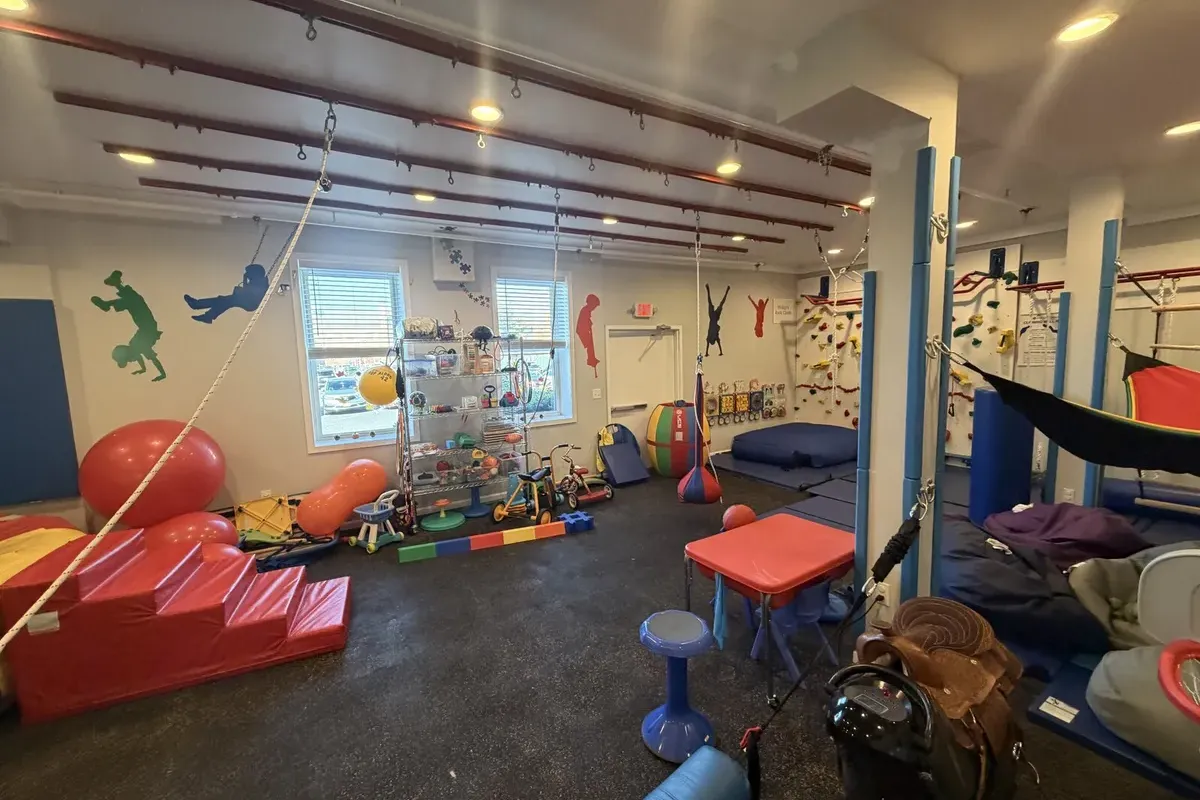
The Holsman Children’s Therapy Center is our dedicated pediatric office at 15-01 Broadway, Suite 14C, Fair Lawn, NJ, for children from birth to age 21. Physical, occupational and speech therapy are under one roof, with a sensory gym (climbing wall, swings, crash pads) and a calm multi-sensory room.
- Call or request a visit. We ask about your concerns and check your insurance.
- Evaluation. A licensed pediatric therapist looks at strength, range of motion, balance, posture and motor milestones, and talks with you about goals.
- A written plan with clear goals, a recommended schedule and activities to try at home.
- Play-based sessions in the sensory gym: obstacle courses, climbing and ball games chosen to build the next skill, with progress reviewed with you regularly.
Insurance: We accept commercial insurance and private pay; we do not accept Medicaid or NJ FamilyCare plans.
You can schedule pediatric physical therapy directly, without a physician referral. Some insurance plans require a referral for coverage; our team will check your child’s plan before the first visit. Call 1-855-465-7626 (or the Children’s Center directly at 201-351-1682), or use the form on this page.
Related reading: 10 Signs Your Child May Benefit from Pediatric Occupational Therapy · Speech and Language Milestones · When to Refer for Pediatric PT, OT or Speech
Frequently Asked Questions
What does a pediatric physical therapist treat?
Pediatric physical therapists treat gross motor delays and missed milestones, toe walking, low muscle tone, torticollis, balance and coordination difficulties, and conditions such as cerebral palsy, Down syndrome and sports or orthopedic injuries.
When should my child see a physical therapist?
Talk with your child's doctor and consider an evaluation if your child isn't meeting motor milestones, has lost skills, seems stiff or floppy, still toe walks after age 2, has a head tilt, or falls much more than other children. The CDC advises acting early rather than waiting.
Is toe walking normal?
Toe walking is common while toddlers are learning to walk. The American Academy of Pediatrics says walking on the toes after 2 years of age should be evaluated by your pediatrician.
Where can I find pediatric physical therapy near me in New Jersey?
The Holsman Children's Therapy Center is at 15-01 Broadway, Suite 14C, Fair Lawn, NJ, and sees children from birth to age 21 for physical, occupational and speech therapy. We accept commercial insurance and private pay; we do not accept Medicaid or NJ FamilyCare plans.
Do I need a referral for pediatric physical therapy?
You can schedule pediatric physical therapy directly, without a physician referral. Some insurance plans require a referral for coverage, so our team checks your child's plan before the first visit.
Sources
- Centers for Disease Control and Prevention. Learn the Signs. Act Early.: Milestones by 18 Months. Updated May 2026. Accessed November 2026.
- Centers for Disease Control and Prevention. Concerned About Your Child’s Development? Updated February 2026. Accessed November 2026.
- American Academy of Pediatrics, HealthyChildren.org. Is Your Baby’s Physical Development on Track?. Accessed November 2026.
- American Academy of Pediatrics, HealthyChildren.org. Shoes for Active Toddlers. Accessed November 2026.
- American Academy of Pediatrics, HealthyChildren.org. Head Tilt (Torticollis). Accessed November 2026.
- Sargent B, Coulter C, Cannoy J, Kaplan SL. Physical Therapy Management of Congenital Muscular Torticollis: A 2024 Evidence-Based Clinical Practice Guideline From the American Physical Therapy Association Academy of Pediatric Physical Therapy. Pediatric Physical Therapy. 2024;36(4):370–421. doi:10.1097/PEP.0000000000001114. Accessed November 2026.
- MedlinePlus Medical Encyclopedia, U.S. National Library of Medicine. Hypotonia. Accessed November 2026.
This article is for general education and isn't a substitute for an evaluation by a licensed clinician.