Autism is about more than social skills. Many autistic children also work hard at moving, handling sensory input and communicating. Here is how pediatric physical, occupational and speech therapy can help, and what a visit to our Fair Lawn children's center looks like.
When parents hear the word autism, they often think first about talking and social skills. Those matter. But many families also notice other things: a child who trips often, avoids the playground, covers their ears at the sound of a hand dryer, or melts down when getting dressed.
These are not "bad behaviors." They are often signs that a child's body and senses are working differently. The good news is that pediatric therapy can build skills in each of these areas, through play, at your child's pace.
Autism Is Common, and Every Child Is Different
About 1 in 31 eight-year-olds in the United States has been identified with autism spectrum disorder, and it is found in every racial, ethnic and income group (CDC, 2025). No two autistic children look the same.
The CDC notes that autistic children often have differences in social communication and repetitive behaviors or interests. Many also have delayed language, delayed movement skills, unusual reactions to how things sound, look or feel, and differences in eating and sleeping (CDC, 2024).
The American Academy of Pediatrics recommends autism screening for all children at their 18- and 24-month checkups, because autism can be diagnosed that early and support can improve how a child functions (AAP, 2020). If you have concerns at any age, talk to your pediatrician. You do not have to wait for a diagnosis to get help with motor, sensory or speech skills.
Movement: Why Motor Skills Matter
Motor differences are one of the most overlooked parts of autism. In a large national study of nearly 14,000 autistic children, about 88% were at risk for motor impairment, affecting both big-body and hand skills (Bhat, 2021). Yet motor skills are not part of the formal diagnosis, so they can be missed.
Common motor challenges include:
- Motor planning (praxis): trouble figuring out how to do a new movement, like pumping a swing or climbing a ladder
- Balance and coordination: frequent falls, clumsy running, or difficulty catching and kicking a ball
- Low muscle tone and core weakness: slumping in a chair, tiring quickly, or "W-sitting"
- Toe walking and other differences in how a child walks
These skills shape whether a child can join friends at recess or sit upright long enough to learn.
How Pediatric Physical Therapy Helps
A pediatric physical therapist starts with a full evaluation of strength, balance, coordination, posture and motor milestones. Then therapy becomes play with a purpose. In our sensory gym, that might mean:
- Obstacle courses that practice planning and sequencing movements
- Climbing wall and climbing net work for strength, motor planning and body awareness
- Balance games on beams, cushions and swings
- Ball skills for coordination, timing and turn-taking
- Jumping and crash pad activities for leg strength and safe, organizing movement
Research supports this kind of active approach. A 2025 review of 23 randomized trials found that structured exercise programs improved motor skills, coordination and social skills and reduced behavior problems in autistic children, with the best results when programs fit the child's age and interests (Wang et al., 2025). Movement also gives natural practice in following directions and taking turns.
Sensory Processing: Feeling Calm and Ready
Many autistic children experience the senses differently. A review of 14 studies found sensory differences were much more common in autistic children than in their peers. The biggest gap was in under-responsiveness (not noticing input, like a name being called or a scraped knee), followed by over-responsiveness and sensation seeking (Ben-Sasson et al., 2009).
In daily life, that can look like:
- Strong reactions to noise, bright lights, tags in clothing or certain food textures
- Constant crashing, spinning, jumping or chewing on objects
- Seeming "zoned out" or slow to respond
- Meltdowns during haircuts, tooth brushing or busy outings
How Pediatric Occupational Therapy Helps
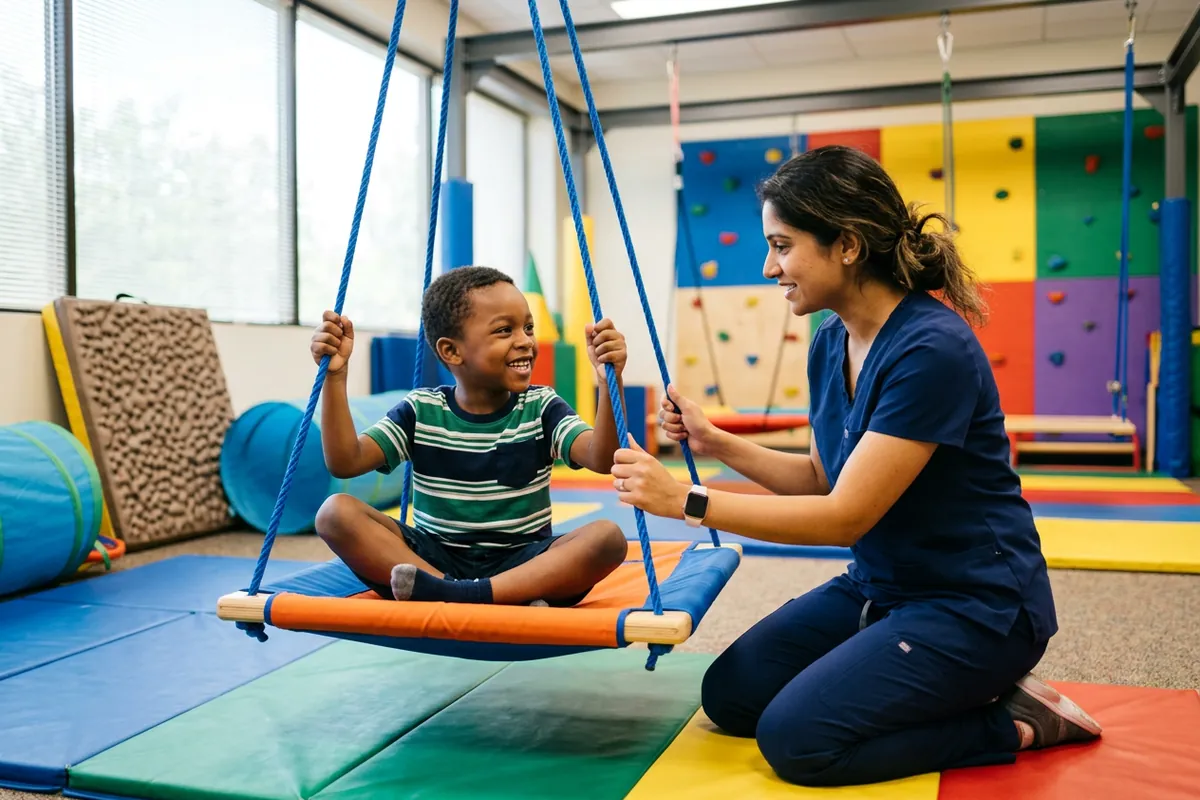
Occupational therapists help children make sense of sensory input so they feel calm, alert and ready to learn. Sessions use swings, textures, heavy work and quiet spaces to help a child's nervous system settle. Then the therapist links those gains to real tasks.
There is good evidence behind this. In a randomized trial of autistic children ages 4 to 8, children who received 30 sessions of a structured sensory-integration-based occupational therapy program reached more of their individual goals and needed less caregiver help with self-care than children in usual care (Schaaf et al., 2014).
OT goals often include:
- Self-care: dressing, buttons and zippers, tooth brushing, feeding and toileting routines
- Fine motor skills: grasp, cutting with scissors, drawing and handwriting
- Self-regulation: learning what helps the body calm down or wake up, and using those tools at home and school
- Feeding: gently widening the range of foods a child will accept
Our post on signs your child may benefit from occupational therapy covers more examples.
Communication: How Speech Therapy Helps
Communication looks different for every autistic child. Some children are late talkers. Some speak fluently but find back-and-forth conversation hard. Others communicate best with pictures, signs or a device. A speech-language pathologist meets your child where they are.
Speech therapy may focus on:
- Understanding words, directions and questions
- Expressing wants, needs and feelings with words, gestures or alternative communication
- Social communication, such as taking turns, sharing attention and playing together
- Clear speech sounds
- Oral-motor and feeding skills
Parent coaching is a big part of this work, because short, everyday practice at home is where much of the progress happens. If you are wondering whether your child's speech is on track, see our guide to speech and language milestones and when to get evaluated.
Why Working Together Matters
A child's skills are connected: a child who feels calmer in their body is often more ready to talk. That is why our physical therapists, occupational therapists and speech-language pathologists share goals and talk with each other about each child.
We respect each child's way of being in the world. Our aim is not to change who your child is. It is to build skills, comfort and independence that matter to your family, and to help your child join in more fully at home, at school and in the community.
When to talk to your pediatrician promptly
- Your child loses words, social skills or motor skills they once had, at any age
- Your child does not respond to their name or uses few or no gestures by their first birthday
- Seizures, staring spells or sudden changes in behavior
- Feeding problems that cause weight loss, choking or dehydration
- Self-injury or wandering that puts your child at risk
Therapy works best alongside your child's medical care, not in place of it.
Our Fair Lawn Children's Therapy Center
The Holsman Children's Therapy Center is at 15-01 Broadway, Suite 14C, in Fair Lawn, NJ, serving families across Bergen and Passaic counties. Pediatric physical, occupational and speech therapy are all under one roof, so families can coordinate care without driving between offices.
- Sensory gym with a climbing wall, monkey bars, climbing net, suspended swings, crash pads and tunnels
- Multi-sensory room, a calmer space for regulation and focused work
- Play-based sessions with clear, measurable goals set with each family
- Home programs and parent coaching so progress carries over between visits
Please note that we do not provide ABA therapy. If your child works with an ABA or school team, we are happy to coordinate with them with your permission.
Getting Started
You can schedule physical therapy, occupational therapy and speech therapy directly. Some insurance plans require a referral for coverage; our staff will verify your benefits. Learn more on our insurance page.
Call the Children's Therapy Center at 201-351-1682 or our main line at 1-855-465-7626, or contact us to schedule an evaluation.
Frequently Asked Questions
Can physical therapy help a child with autism?
Yes. Many autistic children have differences in balance, coordination and motor planning. A pediatric physical therapist builds these gross motor skills through play so your child can keep up on the playground, in gym class and in daily routines.
What is the difference between PT and OT for autism?
Physical therapy focuses on big-body movement such as balance, strength, running, jumping and stairs. Occupational therapy focuses on hand skills, self-care, sensory processing and self-regulation. Many children benefit from both, and our team coordinates goals between them.
Does my child need an autism diagnosis to start therapy?
No. Children are evaluated based on the skills they are having trouble with, such as motor, sensory or communication skills. Therapy can start while your family is still going through the diagnosis process with your pediatrician or a specialist.
Do you offer ABA therapy?
No. The Holsman Children's Therapy Center provides pediatric physical, occupational and speech therapy. We do not provide ABA. If your child receives ABA elsewhere, we are glad to coordinate goals with your child's team when you give permission.
Is therapy a cure for autism?
No. Autism is a lifelong difference in how the brain develops, not a disease to cure. Therapy aims to build skills, comfort and independence so your child can take part more fully at home, at school and in the community.
Do I need a referral for pediatric therapy?
You can schedule physical therapy, occupational therapy and speech therapy directly. Some insurance plans require a referral for coverage; our staff will verify your benefits.
Sources
- Data and Statistics on Autism Spectrum Disorder. Centers for Disease Control and Prevention (CDC), 2025. https://www.cdc.gov/autism/data-research/index.html
- Signs and Symptoms of Autism Spectrum Disorder. Centers for Disease Control and Prevention (CDC), 2024. https://www.cdc.gov/autism/signs-symptoms/index.html
- Hyman SL, Levy SE, Myers SM; AAP Council on Children With Disabilities. Identification, Evaluation, and Management of Children With Autism Spectrum Disorder. Pediatrics (American Academy of Pediatrics), 2020. https://pubmed.ncbi.nlm.nih.gov/31843864/
- Bhat AN. Motor Impairment Increases in Children With Autism Spectrum Disorder as a Function of Social Communication, Cognitive and Functional Impairment, Repetitive Behavior Severity, and Comorbid Diagnoses: A SPARK Study Report. Autism Research, 2021. https://pubmed.ncbi.nlm.nih.gov/33300285/
- Ben-Sasson A, et al. A Meta-Analysis of Sensory Modulation Symptoms in Individuals With Autism Spectrum Disorders. Journal of Autism and Developmental Disorders, 2009. https://pubmed.ncbi.nlm.nih.gov/18512135/
- Schaaf RC, et al. An Intervention for Sensory Difficulties in Children With Autism: A Randomized Trial. Journal of Autism and Developmental Disorders, 2014. https://pubmed.ncbi.nlm.nih.gov/24214165/
- Wang Y, et al. The Impact of Physical Exercise Interventions on Social, Behavioral, and Motor Skills in Children With Autism: A Systematic Review and Meta-Analysis of Randomized Controlled Trials. Frontiers in Pediatrics, 2025. https://pubmed.ncbi.nlm.nih.gov/40083436/
This article is for general education and isn't a substitute for an evaluation by a licensed clinician.