Every child learns to talk at their own pace, but there are general age ranges for speech and language skills. Here is what is typical, which signs mean it is time to get an evaluation, and how speech therapy helps.
If you have ever compared your toddler to a cousin or a classmate and wondered why they are not saying as much, you are not alone. Questions about talking are some of the most common concerns parents bring to their pediatrician.
The good news: children develop on a range, not a single schedule. And when a child does need support, starting early makes a real difference. Research consistently shows that early help for speech and language is more effective than waiting.
Speech and Language Milestones by Age
The milestones below reflect general guidance from groups like the American Speech-Language-Hearing Association (ASHA) and the CDC. Most children reach them by the age listed. Think of them as a guide, not a test.
By 12 months
- Babbles with consonant sounds, like "bababa" or "dadada"
- Uses gestures such as waving bye-bye or reaching to be picked up
- Responds to their name and understands "no"
- May say a first word, like "mama" or "dada," around the first birthday
By 18 months
- Says several single words besides "mama" and "dada"
- Points to show you something interesting
- Follows simple one-step directions, like "give me the ball"
By 2 years
- Puts two words together, like "more milk" or "daddy go"
- Vocabulary is growing quickly, often to dozens of words
- Points to pictures in a book when you name them
By 3 years
- Uses short sentences and asks simple "what" and "where" questions
- Has short back-and-forth conversations
- Family and caregivers understand most of what they say
By 4 years
- Speaks in sentences of four or more words
- Tells you about something that happened during the day
- Most people, even strangers, can understand most of their speech
By 5 years
- Tells a simple story with a beginning and an end
- Answers questions about a story you read together
- Speech is mostly clear. Some harder sounds, like "r," "l" and "th," may still be developing
Late Talker, Speech Delay, Language Delay or Articulation? What the Terms Mean
Parents hear many different terms. They describe different things, which is why an evaluation matters.
- Late talker: a toddler, usually between about 18 and 30 months, who understands well, plays well and uses gestures, but says fewer words than expected. Many catch up on their own, but some do not, and there is no reliable way to tell in advance.
- Speech delay: trouble making the sounds of speech. The child may know what they want to say but has a hard time saying it clearly.
- Language delay: trouble understanding words (receptive language), using words and sentences (expressive language), or both. A child may speak clearly but use very short sentences or struggle to follow directions.
- Articulation or speech sound disorder: ongoing trouble with specific sounds past the age when most children have mastered them, such as saying "wabbit" for "rabbit" well into school age, or leaving off many sounds.
Some children have more than one of these at the same time. A licensed speech-language pathologist (SLP) can sort out what is going on.
Warning Signs: When to Get an Evaluation Now
You do not need to wait for a well visit if you notice any of these:
- No babbling by 12 months
- No single words by 16 to 18 months
- Not combining two words by 2 years
- Hard for family to understand by age 3
- Stuttering that comes with visible tension, facial strain, frustration, or avoiding talking
- Trouble following simple directions or not seeming to understand what you say
- Your gut tells you something is not right
When to call your pediatrician right away
- Your child loses words or skills they used to have, at any age
- Your child does not respond to sounds or to their name
- Speech changes suddenly after an illness, injury or fall
- Choking, coughing or gagging often while eating or drinking
These signs need a medical check. A speech evaluation can happen alongside, but your pediatrician should know first.
Start With a Hearing Check
Children learn to talk by hearing. Even a mild or on-and-off hearing loss, such as fluid behind the ears after frequent ear infections, can slow speech and language. Passing the newborn hearing screen does not rule out hearing changes later on.
If your child has a speech or language concern, ask your pediatrician about a hearing test with an audiologist. It is quick, painless and an important first step.
What Happens at a Speech-Language Evaluation
A pediatric speech evaluation is relaxed and play-based. Most children simply think they are playing. A typical evaluation includes:
- Parent interview: your child's history, milestones, health, hearing and your main concerns
- Play and observation: how your child communicates with toys, books and people
- Standardized testing: age-appropriate activities that look at understanding, talking and speech sounds
- Oral-motor check: how the lips, tongue and jaw move for speech and eating
- Results and next steps: what the SLP found, whether therapy is recommended, and ideas you can use at home right away
How Pediatric Speech Therapy Works
Good speech therapy for young children looks like play, because play is how children learn best. Sessions use games, books, songs and toys built around clear goals, such as adding new words, putting words together or practicing a tricky sound.
Parents are part of the team. Your therapist will coach you on simple strategies to use during everyday routines like bath time, meals and car rides. Short, frequent practice at home often matters as much as the session itself.
Some children also benefit from occupational therapy for fine motor, feeding or sensory needs. Having speech, OT and PT in one place makes it easier to coordinate care.
Simple Ways to Build Language at Home
- Narrate your day. "I'm washing the red cup. Splash!"
- Expand what they say. If your child says "car," you say "big car" or "blue car goes fast."
- Pause and wait. Give your child a few seconds to respond before you fill the silence.
- Read every day. Point to pictures, name them and ask simple questions.
- Offer choices. "Apple or banana?" invites a word instead of a point.
- Sing and play. Songs with actions and repeated words are great practice.
- Get face to face. Let your child see your mouth when you talk.
- Model, don't correct. If they say "tat," simply reply, "Yes, a cat!" without asking them to repeat it.
- Limit background screens. Back-and-forth talk with you helps far more than videos.
Pediatric Speech Therapy at Holsman Children's Therapy Center in Fair Lawn
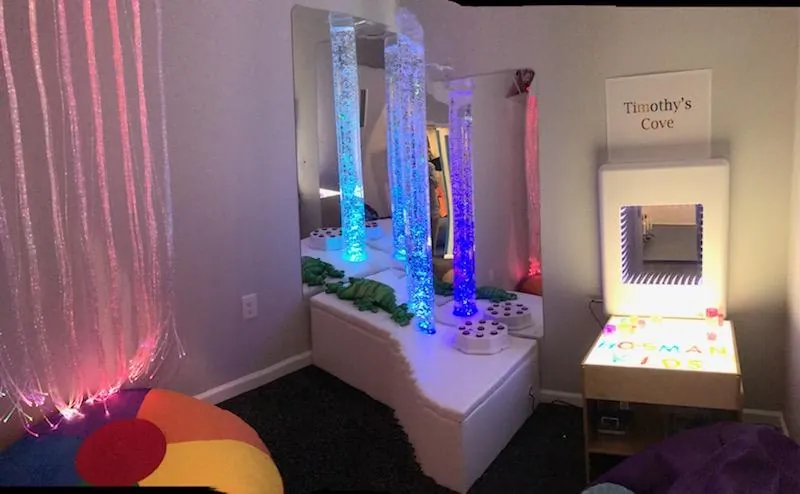
Holsman Children's Therapy Center is at 15-01 Broadway, Suite 14C, Fair Lawn, NJ. Our pediatric team offers speech therapy, occupational therapy and physical therapy, with a sensory gym and a multi-sensory room designed for children. Learn more on our pediatric therapy page, or call the center directly at 201-351-1682.
Families visit from Fair Lawn and nearby towns across Bergen and Passaic counties, including Paterson and Clifton. Parents can also get their own care at our Fair Lawn adult clinic in the same building.
You can schedule physical therapy, occupational therapy and speech therapy directly. Some insurance plans require a referral for coverage; our staff will verify your benefits. See our insurance page or contact us with questions.
Frequently Asked Questions
Should we just wait and see if my toddler catches up?
Many late talkers do catch up, but there is no reliable way to know ahead of time which children will. An evaluation does not commit you to therapy. It gives you a clear picture, and if your child is on track, you leave with peace of mind and ideas to try at home.
Does learning two languages cause a speech delay?
No. Children raised with two languages reach milestones within the same general age ranges as children who learn one. They may mix languages or know some words in only one language, which is normal. When counting words, count all languages together.
Is it true that boys talk later than girls?
On average the difference is small, and it is not a reason to delay getting help. Use the same milestones for every child and talk to a professional if your child is behind.
Do I need a referral for a pediatric speech evaluation?
You can schedule physical therapy, occupational therapy and speech therapy directly. Some insurance plans require a referral for coverage; our staff will verify your benefits.
How long does speech therapy take?
It depends on the child, the type of difficulty and how often skills are practiced at home. Your speech-language pathologist will set goals, track progress and review the plan with you regularly.
This article is for general education and isn't a substitute for an evaluation by a licensed clinician.