Every child grows at their own pace. But if buttons, pencils, noisy rooms or the playground seem harder for your child than for other kids, pediatric occupational therapy may help.
As a parent, you know your child best. Maybe you've noticed that getting dressed is a daily battle, handwriting brings tears, or birthday parties feel overwhelming. These moments don't mean anything is "wrong." They may simply mean your child could use some extra support to build the skills they need for play, school and everyday life.
That's what pediatric occupational therapy (OT) is for. In OT, a child's "occupations" are the things kids do all day: playing, learning, eating, dressing and getting along with others. Below are 10 common signs that an OT evaluation could be helpful, plus what to expect and how you can help at home.
10 Signs Your Child May Benefit from Occupational Therapy
1. Trouble with fine motor skills or handwriting
Your child may hold a pencil or crayon awkwardly, press too hard or too softly, tire quickly when writing, or struggle with scissors, beads or small toys. Handwriting may be hard to read compared with classmates.
2. Difficulty with self-care tasks
Buttons, zippers, snaps, shoelaces and using a fork or spoon may be frustrating. Your child might still need a lot of help with dressing, brushing teeth or washing hands at an age when peers do these on their own.
3. Strong reactions to sensory input (over-responsive)
Some children are very sensitive to sounds, lights, textures or touch. Tags in clothing, hair brushing, messy hands or loud places like a cafeteria may cause big distress.
4. Seeking lots of sensory input (under-responsive)
Other children seem to need more input. They may crash into furniture, chew on shirts or pencils, spin often, or not notice when they're hurt or their face is messy. Both patterns are sensory processing differences, and an OT can help your child respond in ways that work better for them.
5. Challenges with motor planning
Motor planning is the ability to figure out and carry out a new movement. A child who struggles here may seem clumsy, have trouble learning new games, or need many tries to copy simple movements like jumping jacks.
6. Big feelings that are hard to manage
Frequent meltdowns, trouble with transitions, or difficulty calming down can sometimes be linked to how a child processes sensory information. OT teaches calming strategies and helps kids learn what their bodies need to feel regulated.
7. Very picky eating linked to textures or smells
Many kids are picky eaters. But if your child accepts only a very short list of foods, gags at certain textures, or gets upset by food touching on the plate, sensory-based feeding challenges may be part of the picture.
8. Limited play skills
Your child may play with toys in the same way every time, avoid building or pretend play, or have trouble joining play with other kids. Play is how children learn, so it's an important area for OT.
9. Difficulty paying attention to tasks
Trouble sitting for circle time, finishing a puzzle or following steps of a task can have many causes. Sometimes motor, sensory or regulation challenges make it harder to focus, and OT can address those pieces.
10. Poor bilateral coordination or avoiding the playground
Using both hands together, like holding paper while cutting or catching a ball, may be hard. Some children avoid swings, slides and climbing equipment because they feel unsteady or uneasy when their feet leave the ground.
One or two of these signs alone may be part of normal development. If several sound familiar, or if a challenge is affecting your child's confidence, school day or family life, an evaluation can give you clear answers.
What Happens at a Pediatric OT Evaluation?
An evaluation is relaxed and play-based, so most children enjoy it. A licensed occupational therapist will usually:
- Talk with you about your concerns, your child's history and daily routines
- Watch your child play, move, draw and try age-appropriate tasks
- Use standardized tests when appropriate to look at fine motor, visual motor and sensory processing skills
- Share what they found and work with you to set goals that matter to your family
It's important to know that an OT does not diagnose conditions such as autism or ADHD. Those diagnoses come from physicians or psychologists. OT focuses on your child's skills and how to support them, whatever the reason behind the challenge.
What Do OT Sessions Look Like?
To your child, OT sessions often look like play. That's on purpose. Therapists use climbing, swinging, games, crafts and obstacle courses to build strength, coordination and confidence while keeping kids motivated.
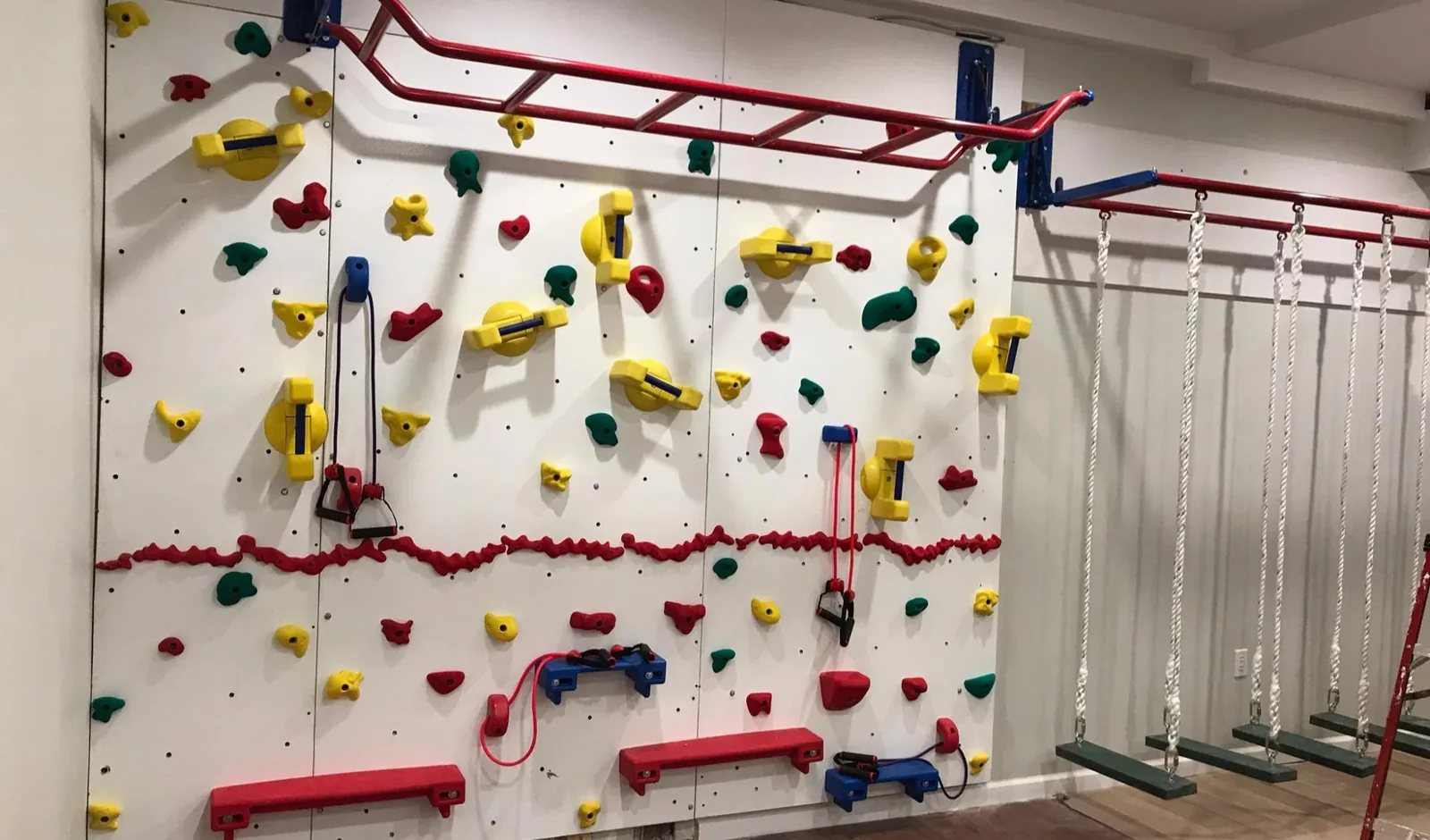
At Holsman Children's Therapy Center in Fair Lawn, sessions take place in a dedicated sensory gym with a climbing wall, swings and mats, as well as a calming multi-sensory room. A session might include swinging to help a child feel organized, a climbing challenge to build strength and motor planning, then a fine motor activity like lacing or drawing at the table. Parents are welcome to ask questions and learn strategies to carry over at home.
How Parents Can Help at Home
Small, everyday activities make a real difference. Your child's therapist will give you ideas that fit your child, but here are some simple starting points:
- Build hand strength: play-dough, tearing paper, picking up small items with tongs, and squeezing sponges in the bath.
- Practice self-care with patience: start with large buttons and zippers, and allow extra time in the morning.
- Offer movement breaks: jumping, carrying a laundry basket or pushing a cart can help some kids feel calm and focused.
- Create a calm corner: a quiet space with soft pillows and a favorite book can help with big feelings.
- Explore food without pressure: let your child touch, smell and help prepare new foods without being asked to eat them.
- Celebrate effort: praise trying, not just succeeding.
When to Also Consider Physical or Speech Therapy
Children's skills are connected, so some kids benefit from more than one kind of therapy. Consider pediatric physical therapy if your child has trouble with walking, running, balance, jumping or keeping up with peers in gross motor play. Consider speech therapy if your child has trouble being understood, using words to communicate, following directions, or with chewing and swallowing.
Holsman Children's Therapy Center offers pediatric PT, OT and speech therapy under one roof, so therapists can work together on shared goals. Learn more on our pediatric therapy and occupational therapy pages. Families closer to Clifton can also see an occupational therapist at our Clifton clinic; learn more about pediatric occupational therapy in Clifton, NJ.
When to call your pediatrician right away
- Your child loses skills they already had, such as words, walking or self-care
- Choking, coughing or trouble breathing during meals, or poor weight gain
- Sudden weakness, new clumsiness, or one side of the body not working like the other
- Concerns about your child's safety, mood or self-harm
Schedule a Pediatric OT Evaluation in Fair Lawn
If something on this list sounds like your child, you don't have to wait and wonder. Holsman Children's Therapy Center is located at 15-01 Broadway, Suite 14C, Fair Lawn, NJ. Call 201-351-1682 or contact us to get started.
You can schedule physical therapy, occupational therapy and speech therapy directly. Some insurance plans require a referral for coverage; our staff will verify your benefits. See our insurance page for details.
Frequently Asked Questions
At what age can a child start occupational therapy?
Children of any age can be evaluated, from infancy through the teen years. The right time is when a daily skill is getting in the way of play, school or family routines. Starting early often makes progress easier.
Does my child need a doctor's referral for pediatric OT?
You can schedule physical therapy, occupational therapy and speech therapy directly. Some insurance plans require a referral for coverage; our staff will verify your benefits.
Does an occupational therapist diagnose autism or ADHD?
No. An occupational therapist evaluates skills such as fine motor control, sensory processing and self-care, and builds a plan to support them. Diagnoses like autism or ADHD are made by physicians or psychologists. If the therapist notices something worth checking, they will suggest talking with your pediatrician.
How long does pediatric occupational therapy take?
It depends on your child's goals. Some children work on one skill for a few months, while others benefit from longer support. Your therapist will review progress with you regularly and adjust the plan.
What should my child wear to an OT session?
Comfortable clothes your child can climb, swing and move in, plus sneakers or socks with grips. Sessions are active and play-based.
This article is for general education and isn't a substitute for an evaluation by a licensed clinician.