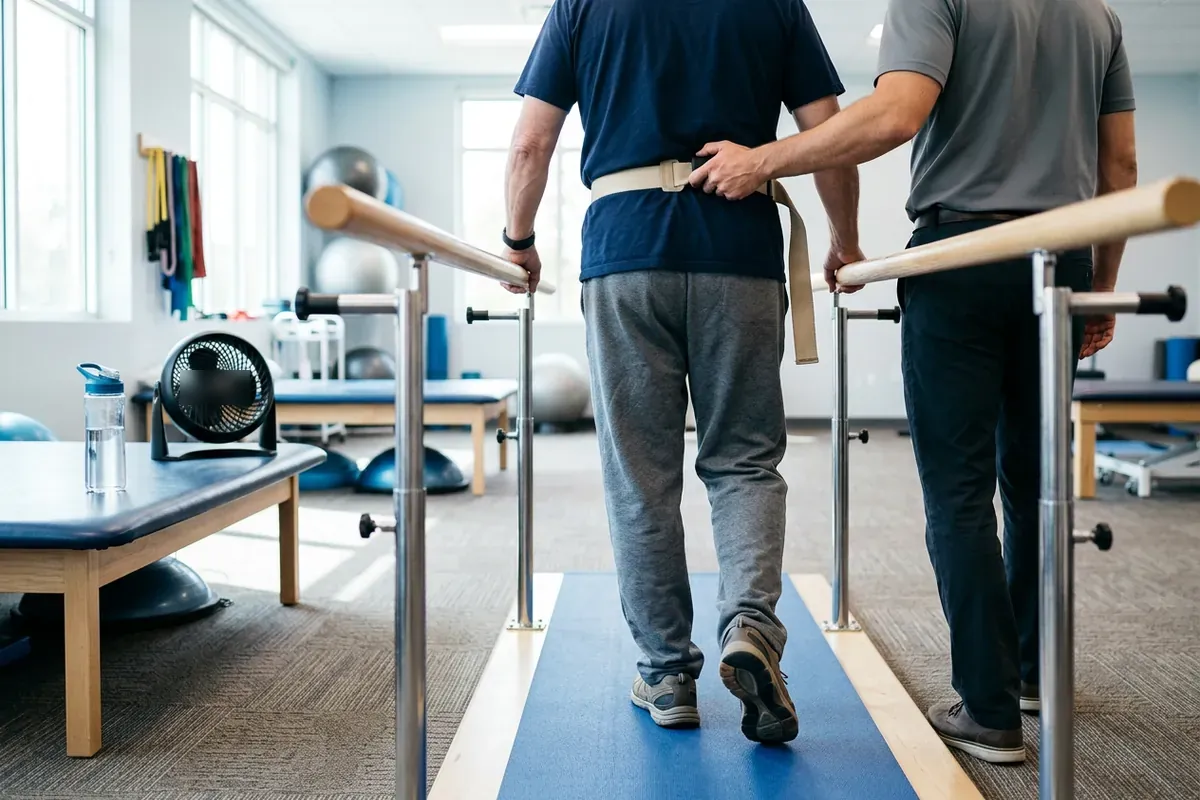
Multiple sclerosis (MS) looks different in every person. One day your legs feel heavy and your balance is off; another day fatigue is the main problem; on a hot afternoon old symptoms seem to come back. Physical therapy will not cure MS, but it can help you stay strong, steady and active at every stage, and help you plan your days around your energy.
This article draws on guidance from APTA’s Academy of Neurologic Physical Therapy (ANPT): the clinical practice guideline A Core Set of Outcome Measures for Adults With Neurologic Conditions Undergoing Rehabilitation (Moore et al., Journal of Neurologic Physical Therapy, 2018) and the ANPT’s MS-EDGE outcome measure recommendations (2012). APTA has not yet published a treatment guideline specific to MS. An ANPT guideline on balance rehabilitation and falls prevention in adults with MS is listed as in development (APTA), so for exercise we also follow the National MS Society’s recommendations, endorsed by the Consortium of Multiple Sclerosis Centers (National MS Society, 2020).
In MS, inflammation in the brain and spinal cord damages myelin, the protective coating around nerves. That slows or disrupts nerve signals and causes the symptoms of MS (National MS Society).
How MS Can Affect Movement
Symptoms vary widely. The National MS Society’s recommendations describe fatigue, unsteadiness and balance problems, sensory changes, walking difficulty, weakness and stiffness, and vision changes, which can range from mild to more limiting over time (National MS Society, 2020). As walking gets harder, falls and difficulty with transfers in and out of chairs become more common (National MS Society, 2020).
Why Start Physical Therapy Early
The National MS Society recommends an early evaluation by a physical or occupational therapist experienced in MS to set up a personal exercise and activity plan, and stresses that exercise is safe for people with MS (National MS Society, 2020). The same recommendations note that supervised training generally gives better results than training on your own, and that referrals to specialists become more important as disability increases (National MS Society, 2020).
What MS Rehab Focuses On
Balance and fall prevention
Your therapist tests your standing and walking balance, then builds a program to challenge it safely. Balance, coordination and agility training aimed at fall prevention is part of the National MS Society’s recommendations (National MS Society, 2020). If you need a cane, walker or brace, your therapist helps you choose and use it; the right mobility aid can help you stay active and safer (National MS Society, 2020). See our fall prevention program and our post on why people fall, and how to prevent it.
Walking (gait)
Gait training and strengthening target the specific reasons walking is harder for you, such as weak hip or ankle muscles or low endurance. For people with more mobility challenges, the recommendations suggest practicing functional movements such as sit-to-stand and stair climbing (National MS Society, 2020).
Fatigue and energy
Even people with mild symptoms may benefit from training by specialists in fatigue and energy management, and in ways to adapt favorite activities (National MS Society, 2020). An occupational therapist can help you adapt daily tasks at home and work.
Strength, flexibility and fitness
For people with milder symptoms, the National MS Society recommendations include aerobic exercise two to three times a week, strength training two to three times a week, daily stretching, and balance work several times a week, building up gradually toward at least 150 minutes a week of exercise or lifestyle activity (National MS Society, 2020). Your therapist adjusts this to your level, and as needs change, so does the plan.
Heat Sensitivity: Keeping Cool While You Exercise
Many people with MS notice their symptoms get worse when they are hot, when it is humid, or when they have a fever. Even a small rise in core body temperature, about a quarter to half a degree, can do it (National MS Society). The good news: heat-related symptoms are temporary. Heat does not cause more disease activity, and symptoms improve once you cool down (National MS Society).
Exercise can temporarily worsen symptoms in people who are heat-sensitive (National MS Society, 2020), so your therapist will help you work around it. Strategies the National MS Society suggests include (National MS Society):
- Exercising in an air-conditioned space or a cool pool (under 85°F), or outdoors early in the morning or in the evening
- Cooling vests, neck wraps or bandanas during exercise
- Light, loose, breathable clothing
- Cold drinks and ice pops
- Cooling down with a cool shower or bath after activity
Cold can be a problem too. Some people find spasticity worse in cold weather (National MS Society).
How Your Progress Is Measured
The ANPT core outcome measures guideline tells therapists to use a standard set of tests, at your first visit, at discharge and when feasible in between, for people whose goals include better balance, walking or transfers and who are able to improve in those areas (ANPT Core Outcome Measures CPG, JNPT 2018). Its grades for chronic progressive conditions (the guideline’s category for conditions that can change over time) are:
- Berg Balance Scale for sitting and standing balance: strong
- Activities-specific Balance Confidence (ABC) Scale for balance confidence: strong
- Functional Gait Assessment for balance while walking: moderate
- 10 Meter Walk Test for walking speed: strong
- 6-Minute Walk Test for walking distance: strong
- Five Times Sit-to-Stand for standing up from a chair: best practice
The guideline also asks therapists to discuss your results with you and decide together how they shape your plan (best practice) (ANPT Core Outcome Measures CPG, JNPT 2018). For MS specifically, the ANPT’s MS-EDGE task force highly recommends measures such as the Timed 25-Foot Walk, the 6-Minute Walk Test, the Berg Balance Scale, the Timed Up and Go with cognitive and manual tasks, and the 12-Item MS Walking Scale for rehab settings (ANPT MS-EDGE, 2012). These tests are given by a clinician, with someone guarding you for safety, so please don’t try the harder balance tests alone.
When to See a Physical Therapist
- You were recently diagnosed and want a safe exercise plan
- You are recovering from a relapse. The National MS Society notes rehab can be especially useful soon after one (National MS Society).
- You have fallen, nearly fallen, or feel less steady
- Walking is slower, shorter, or takes more effort
- Fatigue or heat is keeping you from activities you enjoy
- You are wondering whether a cane, walker or brace would help
When to Call Your Neurologist or 911
This article is general education, not medical advice. Your neurologist manages your MS and its medicines.
- Call your neurologist for sudden new symptoms or a clear worsening of old ones, such as vision loss, new weakness, numbness, balance trouble or severe fatigue, especially if it lasts 24 hours or more. That may be a relapse (National MS Society).
- Call your doctor if symptoms flare along with a fever or signs of an infection, such as burning with urination. A true relapse occurs without an infection or other cause, so infections need to be ruled out and treated (National MS Society).
- Call 911 for sudden face drooping, arm weakness or trouble speaking, a fall with a head injury, or trouble breathing or swallowing.
MS Rehab at Holsman
Our team includes two board-certified neurologic clinical specialists (NCS): our founder, Dr. Richard Holsman, PT, DPT, NCS, and Dr. Mandakini Desai, PT, DPT, NCS, clinic supervisor at our Maplewood and South Orange clinics. We also offer occupational therapy and speech therapy, which can help with daily tasks, thinking skills, speech and swallowing.
You can schedule physical therapy, occupational therapy and speech therapy directly. Some insurance plans require a referral for coverage; our staff will verify your benefits for free. See our insurance page. If getting to a clinic is hard, ask about in-home therapy in Northern New Jersey; in New York, in-home care is provided by our sister practice, Home Therapy PT. Call 1-855-465-7626, contact us, or find a clinic near you. For related reading, see physical therapy for Parkinson’s disease.
Frequently Asked Questions
Can physical therapy help multiple sclerosis?
Physical therapy does not cure MS, but it can help at every stage. A physical therapist can work on strength, balance, walking and endurance, teach energy-saving and fall prevention strategies, help you exercise safely with heat sensitivity, recommend mobility aids, and track your progress with the standard tests recommended in the Academy of Neurologic Physical Therapy core outcome measures guideline (JNPT, 2018).
Is exercise safe if I have MS?
Yes. The National MS Society exercise recommendations, endorsed by the Consortium of Multiple Sclerosis Centers, state that exercise is safe for people with MS and recommend an early evaluation by a physical or occupational therapist experienced in MS to build a personal plan that progresses gradually.
Why do my MS symptoms get worse in the heat?
Even a small rise in core body temperature can make it harder for damaged nerves to carry signals, so symptoms temporarily worsen. The National MS Society notes that heat does not cause more disease activity and symptoms improve after you cool down. Cooling vests, air conditioning, cold drinks and exercising at cooler times can help.
How is a relapse different from a heat-related flare?
According to the National MS Society, a true relapse is new symptoms or a worsening of old ones that lasts at least 24 hours, comes at least 30 days after the last one, and happens without an infection or other cause. Heat-related worsening is temporary and improves after you cool down. Call your neurologist for sudden new or worsening symptoms.
Who treats MS at Holsman?
Our team includes two board-certified neurologic clinical specialists: Dr. Richard Holsman, PT, DPT, NCS, and Dr. Mandakini Desai, PT, DPT, NCS, clinic supervisor at our Maplewood and South Orange clinics. Occupational and speech therapy are also available.
Do I need a referral for physical therapy for MS?
You can schedule physical therapy, occupational therapy and speech therapy directly. Some insurance plans require a referral for coverage; our staff will verify your benefits for free.
Sources
- Moore JL, Potter K, Blankshain K, Kaplan SL, O’Dwyer LC, Sullivan JE. A Core Set of Outcome Measures for Adults With Neurologic Conditions Undergoing Rehabilitation: A Clinical Practice Guideline. Journal of Neurologic Physical Therapy. 2018;42(3):174–220. doi:10.1097/NPT.0000000000000229 (Academy of Neurologic Physical Therapy, APTA). Accessed November 2026.
- Academy of Neurologic Physical Therapy (APTA Neurology Section) Multiple Sclerosis Task Force. MS-EDGE Outcome Measures for In and Out Patient Rehabilitation. 2012. Accessed November 2026.
- American Physical Therapy Association. Clinical Practice Guideline Development and Knowledge Translation Projects (list updated February 2026). Accessed November 2026.
- Kalb R, Brown TR, Coote S, et al. Exercise and lifestyle physical activity recommendations for people with multiple sclerosis throughout the disease course. Multiple Sclerosis Journal. 2020;26(12):1459–1469 (National MS Society; endorsed by the Consortium of Multiple Sclerosis Centers). Accessed November 2026.
- National Multiple Sclerosis Society. Heat & Temperature Sensitivity. Accessed November 2026.
- National Multiple Sclerosis Society. Managing Relapses. Accessed November 2026.
This article is for general education and isn't a substitute for an evaluation by a licensed clinician.