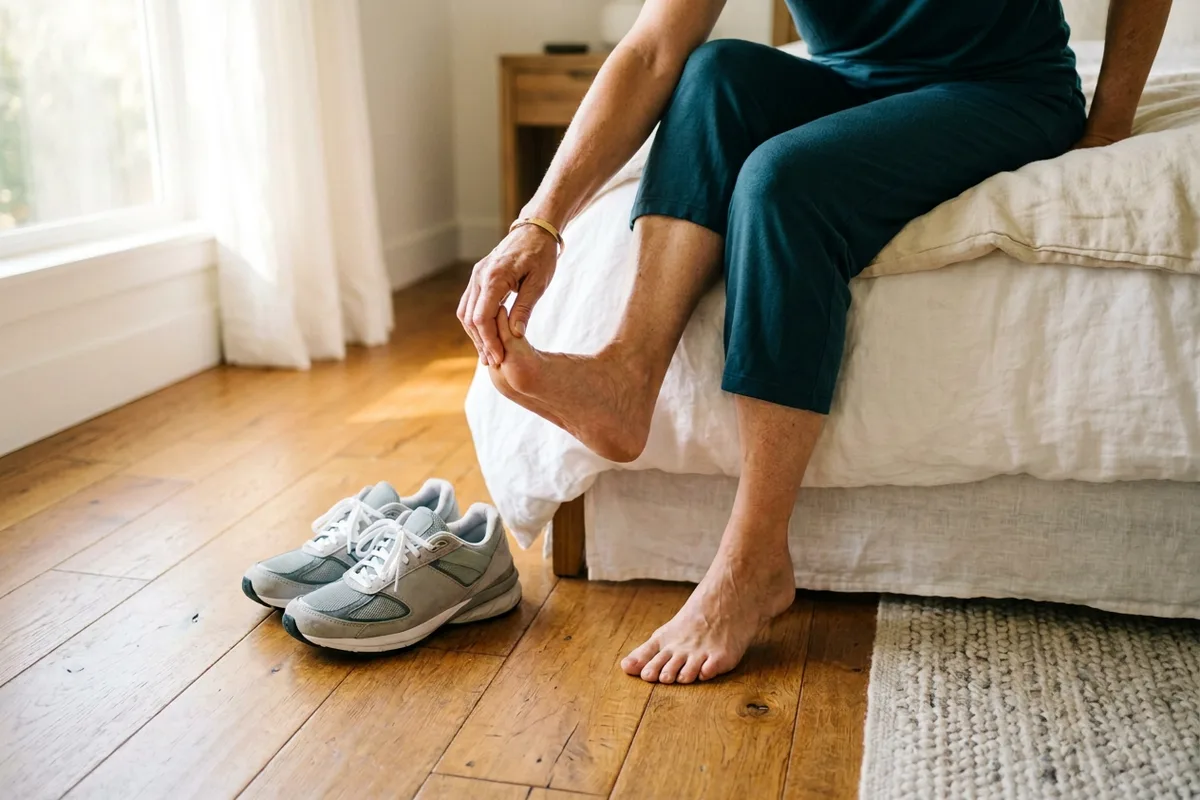
You are in your late 40s or 50s, nothing about your routine has changed, and yet the first steps out of bed now bring a sharp stab under your heel. Many women in the menopause years ask the same question: is this my hormones? The honest answer is “possibly, in part,” and the good news is that the treatment that works is the same either way.
This article builds on our guide to plantar fasciitis and how physical therapy helps, which walks through the APTA heel pain clinical practice guideline in detail. Here we look at what the research says about estrogen, pregnancy and heel pain in women.
Is Heel Pain Common in Women Over 40?
Yes. Plantar fasciitis is most common between the ages of 40 and 60 (NICE CKS). Whether women get it more often than men depends on the study. In a U.S. survey of about 75,000 adults, 1.19% of women reported diagnosed plantar fasciitis with pain in the past month, compared with 0.47% of men, and it was also more common in people aged 45 to 64 (Nahin, J Pain 2018). A large Dutch primary care study also found a higher rate in women, while the APTA’s 2023 guideline found no clear sex difference (NICE CKS). Either way, if you are a woman in midlife with heel pain, you have plenty of company.
Do Hormones Play a Role?
Possibly, but it is not proven. Here is what we know:
- Estrogen affects connective tissue. Researchers now use the term “musculoskeletal syndrome of menopause” for the joint pain, muscle and bone loss, tendon and ligament injuries, frozen shoulder and arthritis progression linked to falling estrogen. They estimate that more than 70% of women have musculoskeletal symptoms during the menopause transition (Wright, Climacteric 2024).
- The plantar fascia responds to hormones. In a small study of young women, the plantar fascia stretched and thinned more under body weight at ovulation, when estrogen peaks, than during menstruation (Lee & Petrofsky 2018). That shows the tissue under your foot is sensitive to hormone changes.
- What is not known is whether lower estrogen after menopause causes plantar fasciitis. No study has shown that. Load on the foot, body weight, tight calves, footwear and long hours standing remain the best-established risk factors (Heel Pain CPG, JOSPT 2023).
What About Pregnancy?
Pregnancy changes feet, and some changes last. In a University of Iowa study of 49 women measured in early pregnancy and again about 19 weeks after delivery, arch height and arch stiffness dropped and feet got slightly longer, with the first pregnancy having the largest effect (Segal 2013). The authors point to the combination of extra body weight and pregnancy hormones that loosen ligaments (Segal 2013). A flatter, more flexible arch puts more strain on the plantar fascia, which is one more reason supportive shoes matter for women who have had children.
Other Conditions Linked to the Menopause Years
Heel pain is rarely the only change. Conditions that physical therapists commonly see in women in midlife include (Wright, Climacteric 2024):
- A stiff, painful shoulder (frozen shoulder, or adhesive capsulitis). See our post on frozen shoulder and physical therapy.
- Tendon pain, such as pain at the Achilles tendon or on the outside of the hip
- General joint aches and progression of arthritis
- Gradual loss of muscle strength and bone density
Strength training is one of the best tools for several of these at once. Wright and colleagues note that resistance exercise, along with good nutrition, may help maintain muscle mass and strength (Wright, Climacteric 2024).
What Helps Heel Pain
The treatments with the strongest evidence work regardless of what started the pain (Heel Pain CPG, JOSPT 2023):
- Stretch every day. Calf stretches against a wall and a gentle plantar fascia stretch, pulling your toes back toward your shin, before your first steps in the morning (AAOS). The APTA guideline gives stretching its strongest grade (Heel Pain CPG, JOSPT 2023).
- Strengthen. Slow heel raises, progressing over several weeks, and other foot and ankle strengthening. The guideline recommends resistance training for these muscles (Heel Pain CPG, JOSPT 2023).
- Wear support at home too. Avoid going barefoot or wearing flat slippers on hard floors while your heel is sore (AAOS).
- Plan for long walking days. Wear your most supportive shoes on days you know you will walk a lot, such as walking to services on the Sabbath or holidays. On fast days when leather shoes are not worn, such as Yom Kippur and Tisha B’Av, choose cushioned non-leather sneakers with arch support rather than thin canvas shoes.
- Build up activity gradually, and include weight-bearing exercise to help keep bones strong.
A physical therapist can add hands-on treatment, taping, a night splint for stubborn morning pain, and a progression plan tailored to you. Our plantar fasciitis guide lists each option with its guideline grade.
When to See a Physical Therapist
- Heel pain lasting more than two to three weeks despite home care
- Pain with the first steps in the morning or after sitting
- Pain that changes how you walk, or makes you cut back on walking or exercise
Talk With Your Physician About
Menopause symptoms, bone density testing, and whether hormone therapy is right for you. Research has not shown that hormone therapy treats heel pain; its role in preventing menopause-related musculoskeletal problems is still being studied (Wright, Climacteric 2024).
When to See a Doctor Promptly
This article is general education, not medical advice. See a doctor promptly for heel pain after a fall or injury, if you cannot put weight on the foot, for swelling, redness, warmth or fever, for numbness or burning in the foot, or for any foot sore if you have diabetes.
Get Help for Heel Pain at Holsman
You can schedule physical therapy, occupational therapy and speech therapy directly. Some insurance plans require a referral for coverage; our staff will verify your benefits for free. See our insurance page for plans we work with.
Our physical therapy teams treat heel pain at our New Jersey and New York clinics. Find the clinic nearest you, call 1-855-465-7626, or contact us to book.
Frequently Asked Questions
Can menopause cause plantar fasciitis?
It may play a part, but it has not been proven. Falling estrogen affects tendons, ligaments, muscle and bone, and the plantar fascia responds to hormone changes. No study has shown that low estrogen alone causes heel pain. Load, body weight, tight calves and footwear remain the best-established risk factors.
Is plantar fasciitis more common in women?
Some studies find it more often in women. A U.S. survey of about 75,000 adults found diagnosed plantar fasciitis with recent pain in 1.19% of women versus 0.47% of men, but the 2023 APTA heel pain guideline found no clear sex difference. It is most common between ages 40 and 60.
Can pregnancy change my feet permanently?
It can. A 2013 study found that arch height and arch stiffness dropped and foot length increased slightly from early pregnancy to about 19 weeks after delivery, with the biggest change after a first pregnancy.
Will hormone therapy fix my heel pain?
Research has not shown that hormone therapy treats heel pain. Talk with your physician about menopause symptoms and hormone therapy. For heel pain itself, stretching, strengthening, supportive shoes and physical therapy have the strongest evidence.
Do I need a referral for physical therapy for heel pain?
You can schedule physical therapy, occupational therapy and speech therapy directly. Some insurance plans require a referral for coverage; our staff will verify your benefits for free.
Sources
- Wright VJ, Schwartzman JD, Itinoche R, Wittstein J. The musculoskeletal syndrome of menopause. Climacteric. 2024;27(5):466–472. doi:10.1080/13697137.2024.2380363. Accessed November 2026.
- Koc TA Jr, Bise CG, Neville C, Carreira D, Martin RL, McDonough CM. Heel Pain – Plantar Fasciitis: Revision 2023. Clinical Practice Guidelines Linked to the International Classification of Functioning, Disability and Health From the Academy of Orthopaedic Physical Therapy and American Academy of Sports Physical Therapy of the American Physical Therapy Association. Journal of Orthopaedic & Sports Physical Therapy. 2023;53(12):CPG1–CPG39. doi:10.2519/jospt.2023.0303. Accessed November 2026.
- Plantar fasciitis: How common is it? (NICE Clinical Knowledge Summaries, revised December 2024). Accessed November 2026.
- Nahin RL. Prevalence and pharmaceutical treatment of plantar fasciitis in United States adults. The Journal of Pain. 2018;19(8):885–896. doi:10.1016/j.jpain.2018.03.003. Accessed November 2026.
- Lee H, Petrofsky J. Differences between men and women in balance and tremor in relation to plantar fascia laxity during the menstrual cycle. Journal of Athletic Training. 2018;53(3):255–261. doi:10.4085/1062-6050-2-17. Accessed November 2026.
- Segal NA, Boyer ER, Teran-Yengle P, Glass NA, Hillstrom HJ, Yack HJ. Pregnancy leads to lasting changes in foot structure. American Journal of Physical Medicine & Rehabilitation. 2013;92(3):232–240. doi:10.1097/PHM.0b013e31827443a9. Accessed November 2026.
- Plantar Fasciitis and Bone Spurs (American Academy of Orthopaedic Surgeons, OrthoInfo). Accessed November 2026.
This article is for general education and isn't a substitute for an evaluation by a licensed clinician.