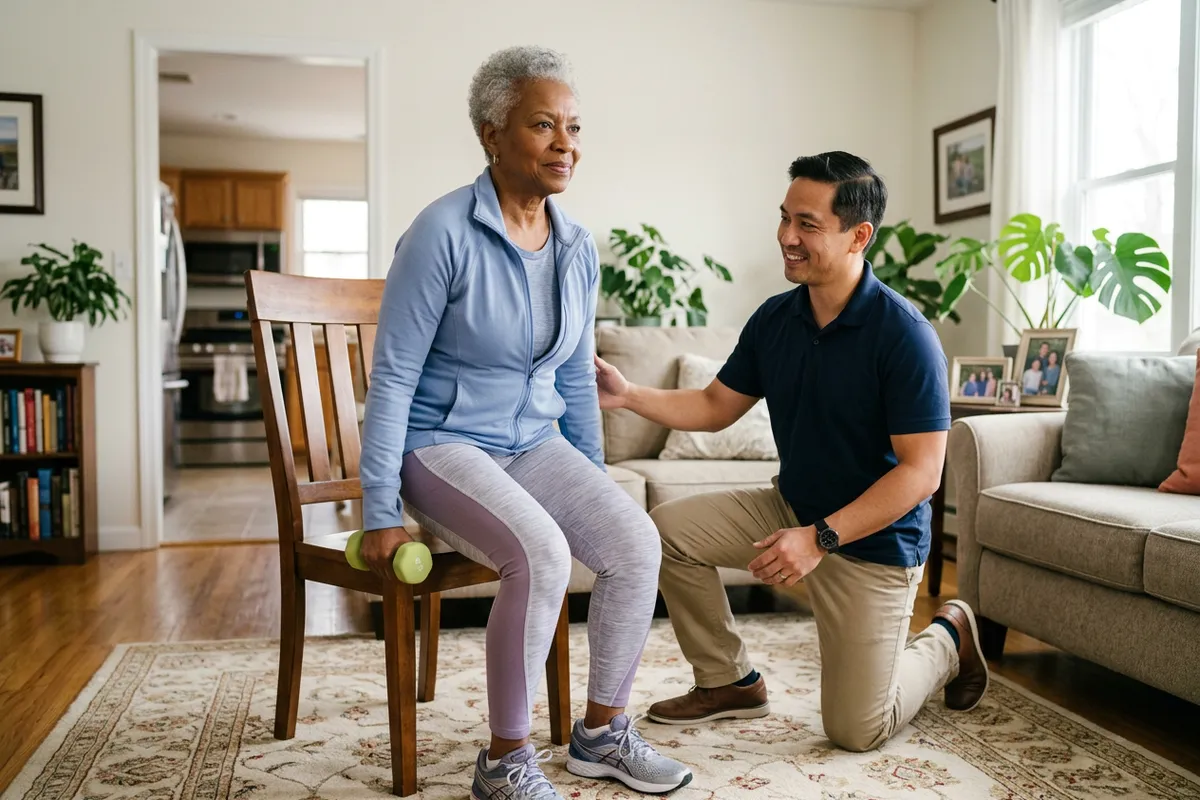
Most people meet a physical therapist after something goes wrong: a fall, a surgery, a back that won't settle down. But some of the most valuable work we do happens before that, helping older adults keep the strength and mobility it takes to live on their own terms.
Getting older is not optional. Losing the ability to climb your stairs, carry your groceries, or get up from the couch without help is a different story. Much of that loss comes from muscles that are not being challenged, and muscles respond to training at any age. APTA Geriatrics puts it simply: older adults respond to strength training much like younger people do, so it is never too late to get stronger (APTA Geriatrics, 2018).
Here is how physical therapy can be a long-term partner for healthy aging.
What Happens to Muscle as We Age
Sarcopenia is the age-related loss of muscle strength, function, and mass. International clinical guidelines estimate it affects roughly 6% to 22% of older adults (Dent et al., 2018). It tends to creep up quietly. You might notice that you push off the armrests to stand, hold the railing on every step, or need to rest halfway through a store.
Weak muscles slow your walking, make balance harder, and make daily tasks tiring. That leads to doing less, which leads to more weakness. Breaking that cycle is a main goal of therapy for older adults.
Strength Training Is the Best-Studied Answer
For people with sarcopenia, the International Conference on Sarcopenia and Frailty Research task force strongly recommends resistance-based training, and endorses progressive strength training as first-line therapy. The same guidelines do not recommend medicines as a first-line treatment (Dent et al., 2018).
The research behind this is large. A Cochrane review of 121 trials with 6,700 older participants found that progressive resistance training had a large effect on muscle strength and improved physical ability, walking speed, and getting out of a chair. Serious problems related to the exercise were rare, though minor joint pain and muscle soreness were common in studies that tracked them (Liu & Latham, 2009).
The National Institute on Aging notes that strength exercises help you stay independent, make it easier to get up from a chair, climb stairs, and carry groceries, slow the loss of muscle mass, and help prevent falls (NIA, 2025).
"Gentle" is not always enough
Strength gains depend on effort. NIA advises working at least at a moderate level, to the point where another repetition would be hard. One set of 8 to 12 repetitions works, and 2 or 3 sets may work better (NIA, 2025). A review in Age and Ageing recommends two full-body sessions a week done with a relatively high degree of effort for older adults with sarcopenia (Hurst et al., 2022).
Many home routines fall short here: leg lifts you can do 30 times without effort may not build much strength. Finding the right challenge safely is a core skill of a physical therapist.
What a Healthy-Aging Week Looks Like
The federal Physical Activity Guidelines for Americans call for older adults to do "multicomponent" activity: balance training plus aerobic and muscle-strengthening activities. They also say older adults should set their effort based on their own fitness level (HHS, 2018). In practice, the CDC recommends that adults 65 and older aim for (CDC, 2025):
- Aerobic activity: at least 150 minutes a week at moderate intensity, such as 30 minutes of brisk walking 5 days a week.
- Strength training: at least 2 days a week, working the legs, hips, back, abdomen, chest, shoulders, and arms.
- Balance activities: such as heel-to-toe walking or practicing standing up from a chair.
The American Geriatrics Society adds flexibility work about 3 times a week and suggests that people at risk for falls do balance training with a trained instructor (AGS, 2026). If health conditions make the full amount hard, the guidelines say to be as active as your abilities allow. Some activity is better than none (CDC, 2025).
For more on the aerobic side and exercising with heart conditions or high blood pressure, see our post on exercise, physical therapy, and your heart.
How Physical Therapy Helps You Stay Independent
Testing, not guessing
Your first visit measures where you are now. Your therapist may time how many times you can stand up from a chair, check your walking speed and balance, and ask what daily tasks have become harder. Those numbers set your starting point and show your progress later. Want a quick look first? Try our free 30-second chair stand self-check.
Training for the life you actually live
Good therapy turns strength into function. If getting off a low couch or carrying laundry upstairs is hard, those movements become part of the plan, with strength, balance, and endurance trained together.
Working around pain and health conditions
Arthritis or back pain keeps many people from exercising; a therapist adjusts exercises so you keep training while pain is treated. If you have chronic conditions, the guidelines say you should understand how they affect safe activity and stay under the care of a health care provider (HHS, 2018). Your therapist follows any limits your physician has given you.
Progressing at the right pace
As you get stronger, the exercises have to get harder to keep working. NIA explains that gradually adding weight, sets, repetitions, or training days builds stronger muscles (NIA, 2025). APTA Geriatrics notes that weight machines are a safe way for beginners to start, and free weights can be added under professional supervision (APTA Geriatrics, 2018).
Start at Home: Our Balance and Strength Program
Our free home balance and strength exercises page is a printable beginner program our therapists often start with: about 15 minutes, 3 days a week, using a sturdy kitchen counter for support. It covers sit-to-stands, heel and toe raises, side leg raises, marching, and supported balance holds.
Once that program feels easy, the next step it describes is the Otago Exercise Programme, a structured home strength and balance program. Moving on to Otago requires clearance from your physical therapist or physician, who can confirm it's safe for you and set the right level. If you have fallen recently, had surgery, or have heart problems, blood pressure problems, or dizziness, check with your doctor or physical therapist before starting any new exercise.
If falls are your main worry, read why seniors fall and how to prevent it, which explains our No Fall Protocol® assessment and HolStep® training levels, available at all of our adult clinics.
When to See a Doctor Right Away
Stop exercising and call 911 for chest pain or pressure, sudden weakness or numbness on one side of the body, face drooping, or trouble speaking. Contact your doctor promptly if you notice:
- Dizziness, nausea, or shortness of breath during activity that doesn't settle with rest (NIA, 2025; AGS, 2026)
- Weakness that is getting worse quickly over days or weeks
- Weakness together with unplanned weight loss, fever, or ongoing fatigue
- A fall with a head strike, new pain, or trouble bearing weight
- Sharp or worsening joint pain, rather than normal muscle tiredness
Getting Started at Holsman
You can schedule physical therapy, occupational therapy and speech therapy directly. Some insurance plans require a referral for coverage; our staff will verify your benefits. See our insurance page for details.
We have 17 clinics across New Jersey and New York, including Lyndhurst, Fair Lawn, Kearny, and the Bronx (Morris Park). If getting to a clinic is hard, our therapists also make house calls: ask about in-home therapy in Northern New Jersey, where you can practice strength and balance in the same rooms and on the same stairs you use every day. In New York, in-home care is provided by our sister practice, Home Therapy PT. Our occupational therapists can also help with daily tasks like dressing and bathing. Call 1-855-465-7626 or contact us.
Frequently Asked Questions
Is it too late to build muscle in my 70s or 80s?
No. Older adults respond to strength training much like younger people do, and research shows progressive strength training improves strength and everyday abilities like getting up from a chair. The key is exercise that is challenging enough and increases gradually, started at a level that is safe for your health.
What is sarcopenia?
Sarcopenia is the age-related loss of muscle strength, function, and mass. It can make walking, climbing stairs, and standing up from a chair harder. International guidelines recommend progressive strength training as the first-line treatment, rather than medicine.
How often should older adults do strength training?
The CDC recommends muscle-strengthening activities at least 2 days a week, working all major muscle groups, plus balance activities and at least 150 minutes a week of moderate aerobic activity. NIA advises not working the same muscle group two days in a row so muscles can recover.
Do I need to be in pain to see a physical therapist?
No. A physical therapist can test your strength, balance, and walking, then build a program to help you stay active and independent, even if nothing hurts.
Can I do these exercises at home, and what is the Otago program?
Yes. Our free home balance and strength exercises page is a printable beginner program. Once it feels easy, the Otago Exercise Programme is a next step, but it requires clearance from your physical therapist or physician first.
Do I need a referral for physical therapy?
You can schedule physical therapy, occupational therapy and speech therapy directly. Some insurance plans require a referral for coverage; our staff will verify your benefits.
Sources
- Centers for Disease Control and Prevention (CDC). Older Adult Activity: An Overview. 2025.
- U.S. Department of Health and Human Services. Physical Activity Guidelines for Americans, 2nd edition: Executive Summary. 2018.
- National Institute on Aging (NIA), NIH. Three Types of Exercise Can Improve Your Health and Physical Ability. 2025.
- American Geriatrics Society, HealthInAging.org. Physical Activity: Lifestyle and Management. 2026.
- APTA Geriatrics, Academy of Geriatric Physical Therapy. Strengthening for Seniors (patient handout). 2018.
- Dent E, Morley JE, Cruz-Jentoft AJ, et al. The Journal of Nutrition, Health and Aging 22(10):1148-1161. International Clinical Practice Guidelines for Sarcopenia (ICFSR): Screening, Diagnosis and Management. 2018.
- Hurst C, Granic A, Buckland C, et al. Age and Ageing 51(2):afac003. Resistance exercise as a treatment for sarcopenia: prescription and delivery. 2022.
- Liu CJ, Latham NK. Cochrane Database of Systematic Reviews (3):CD002759. Progressive resistance strength training for improving physical function in older adults. 2009.
This article is for general education and isn't a substitute for an evaluation by a licensed clinician.