You swing your feet out of bed, stand up, and a sharp, stabbing pain hits the bottom of your heel. After a few minutes of hobbling it eases, only to come back after you sit for a while or finish a long shift. That pattern is the classic sign of plantar fasciitis, one of the most common causes of heel pain.
This article follows the APTA clinical practice guideline Heel Pain – Plantar Fasciitis: Revision 2023 (Koc et al., Journal of Orthopaedic & Sports Physical Therapy, 2023), from APTA’s Academy of Orthopaedic Physical Therapy and American Academy of Sports Physical Therapy. Guideline recommendations are paraphrased for patients. Letters in brackets show the guideline’s own grade for each recommendation: [A] strong evidence, [B] moderate, [C] weak, [D] conflicting, [E] theoretical or foundational, [F] expert opinion.
The plantar fascia is a thick band of tissue that runs from your heel to the ball of your foot and supports your arch. When repeated strain irritates it, the result is heel and arch pain (ChoosePT). Plantar fasciitis affects as many as 2 million Americans a year and about 10% of people at some point in their lives (ChoosePT). The good news is that more than 90% of people improve within 10 months of starting simple treatments (AAOS).
Why the First Steps Hurt Most
The guideline describes the classic pattern: pain on the inside bottom of the heel that is most noticeable with the first steps after a period of rest, like getting out of bed or standing after a long drive, and that also gets worse after long periods on your feet [B] (Heel Pain CPG, JOSPT 2023). It often improves as your foot warms up, then gets worse later in the day (ChoosePT). Many people with plantar fasciitis also have a heel spur on an X-ray, but the spur is not the cause of the pain. Most people with heel spurs have no heel pain at all (AAOS).
Who Gets Plantar Fasciitis?
It is most common in people in their 40s, but it can happen at any age (ChoosePT). Risk factors include (ChoosePT):
- A job, sport or hobby that keeps you on your feet, such as nursing, retail, restaurant work, or running
- A sudden jump in activity, like a new running program or a new job with more standing
- Tight calf muscles and limited ankle motion
- Higher body weight
- Flat feet, or shoes like high heels or worn-out sneakers without good arch support
Self-Care That Helps
- Stretch your calf. Lean against a wall with the painful leg straight behind you and the heel down, the other knee bent in front. AAOS suggests holding for 10 seconds and repeating 20 times for each foot (AAOS).
- Stretch the plantar fascia before your first steps. Sitting, cross the painful foot over the other knee and gently pull your toes back toward your shin. AAOS notes this stretch is best done in the morning before standing or walking (AAOS).
- Wear supportive shoes, including at home. Cushioned soles, a soft heel pad or an arch support can reduce strain. Replace athletic shoes before they wear out (AAOS).
- Use a thick mat if you stand in one place for much of the day (ChoosePT).
- Ease off high-impact activity for a while, and try cycling or swimming instead (AAOS).
- Roll your foot on a cold water bottle for pain relief (AAOS).
- Build back up gradually with a warm-up before exercise (ChoosePT).
If you use over-the-counter anti-inflammatory medicine, AAOS advises talking with your doctor before using it for more than a month (AAOS).
How Physical Therapy Treats Heel Pain
Your physical therapist confirms that plantar fasciitis is the likely cause. The guideline asks therapists to consider other causes of heel pain, including spondyloarthritis, loss of the heel’s fat pad and plantar fibroma, when your symptoms don’t fit the usual pattern [C] (Heel Pain CPG, JOSPT 2023). They also look at your foot posture, ankle motion, strength and how you walk (ChoosePT).
The 2023 guideline’s treatment recommendations include (Heel Pain CPG, JOSPT 2023):
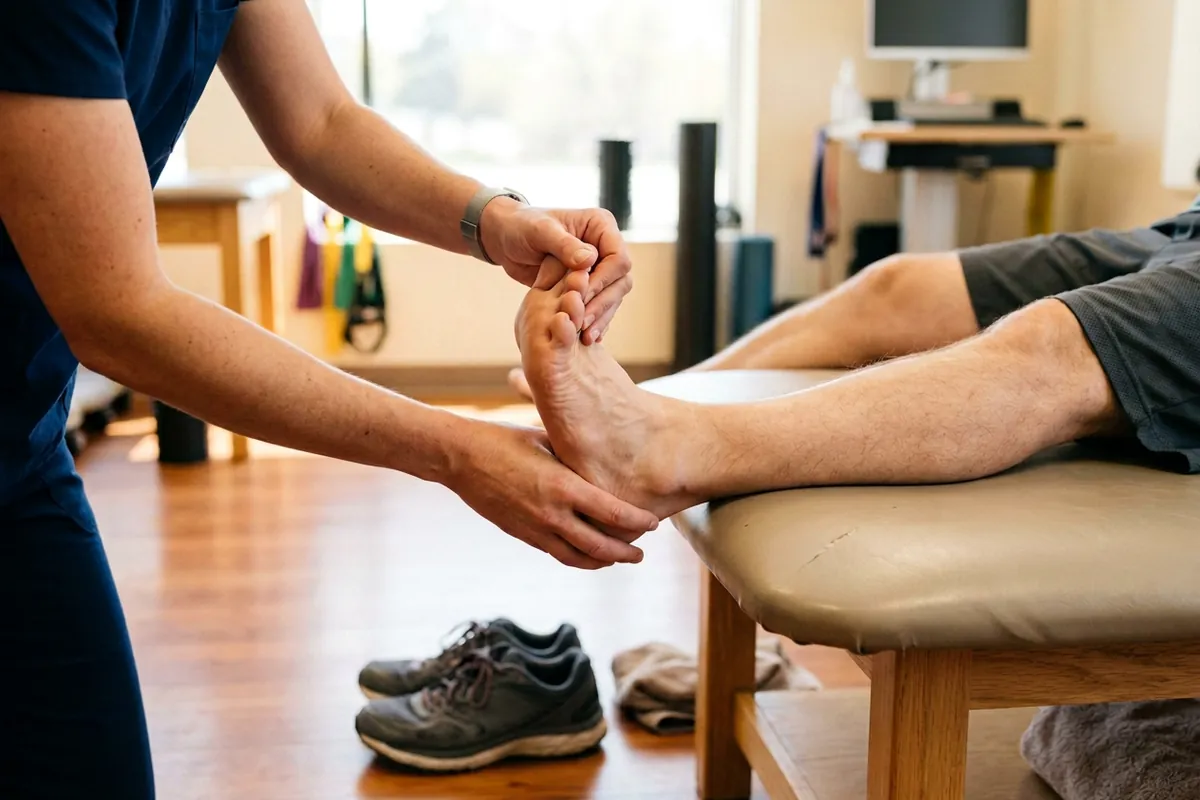
- Manual therapy to the joints and soft tissues of the leg, ankle and foot to improve motion, ease pain and improve function [A]
- Plantar fascia and calf (gastrocnemius/soleus) stretching for short- and long-term pain relief and better function [A]
- Taping of the foot, rigid or elastic, together with other treatment, for short-term relief [A]
- Night splints for one to three months if you consistently have pain with your first steps in the morning [A]
- Resistance training for the muscles of the foot and ankle [B]
- Dry needling of trigger points in the calf and foot muscles for short- and long-term pain relief [B]
- Low-level laser therapy as part of a rehab program for short-term pain relief [B]
- Shoe inserts (orthoses) should not be used as the only treatment for short-term pain relief [B], but may be combined with other treatment [C]
The guideline also recommends against using ultrasound to boost the effects of stretching [A] (Heel Pain CPG, JOSPT 2023). Not every option is offered at every clinic; your therapist will explain what fits your plan.
What About Shockwave Therapy?
Extracorporeal shockwave therapy (ESWT) is sometimes tried for heel pain that has not improved. AAOS describes the research as mixed, though it is non-invasive and low risk (AAOS). The 2023 guideline did not grade it, because the authors considered it outside the scope of physical therapist practice for that update; they included a separate summary of the research instead (Heel Pain CPG, JOSPT 2023). If you are interested, ask whether it fits your plan. Learn more on our shockwave therapy page. Many health plans, including Medicare, do not cover shockwave therapy, and our staff will explain any cost before treatment.
Dry needling is available at our Lyndhurst, Caldwell, Fair Lawn and Cedar Grove clinics. Medicare does not cover dry needling; see our dry needling page.
Track How You Are Doing
The guideline recommends that therapists track progress with a validated foot questionnaire such as the Foot and Ankle Ability Measure (FAAM), Foot Health Status Questionnaire or Foot Function Index [A] (Heel Pain CPG, JOSPT 2023). Your therapist will give you one at your visit. Before then, you can fill out our free Lower Extremity Functional Scale (LEFS), a general leg-function questionnaire, and the Pain Disability Index. They are a starting point, not a diagnosis.
When to See a Physical Therapist
- Heel pain that has lasted more than a couple of weeks despite stretching and better shoes
- First-step pain every morning
- You are limping, or have cut back on walking, work or exercise
- You stand all day for work and the pain is getting worse by the end of each shift
- You want to get back to running or sports safely
Surgery is rarely needed. AAOS generally reserves it for people who have not improved after 12 months of nonsurgical treatment (AAOS).
When to See a Doctor Promptly
This article is general education, not medical advice. See a doctor promptly, or get urgent care, for:
- Heel pain after a fall, jump or injury, or if you cannot put weight on the foot
- Swelling, redness or warmth in the foot, or fever
- Numbness, tingling or burning in the foot
- Pain at night or at rest that does not ease
- Diabetes with any foot sore, wound or color change
Get Help for Heel Pain at Holsman
You can schedule physical therapy, occupational therapy and speech therapy directly. Some insurance plans require a referral for coverage; our staff will verify your benefits for free. See our insurance page for plans we work with.
Our physical therapy and sports physical therapy teams treat heel pain at our New Jersey and New York clinics, including Kearny, Bloomfield, Rahway and Brooklyn. Find the clinic nearest you, call 1-855-465-7626, or contact us to book.
Frequently Asked Questions
Why does plantar fasciitis hurt most in the morning?
Pain from plantar fasciitis is usually worst with the first steps after rest, such as getting out of bed or standing after sitting, and after long periods on your feet. It often eases as the foot warms up. A plantar fascia stretch before your first steps can help.
How long does plantar fasciitis take to go away?
It varies. The American Academy of Orthopaedic Surgeons reports that more than 90% of people improve within 10 months of starting simple treatments such as stretching, supportive shoes and activity changes. Physical therapy can help you follow a structured plan.
Is a heel spur causing my pain?
Usually not. Many people with plantar fasciitis have a heel spur on an X-ray, but AAOS notes that most people with heel spurs have no heel pain, and plantar fasciitis can be treated without removing the spur.
What shoes are best for plantar fasciitis?
Choose shoes with good arch support, cushioned soles and a moderate heel, and replace athletic shoes before they wear out. Avoid going barefoot on hard floors while your heel is sore. A soft heel pad or arch support may help; a physical therapist can advise you.
Does physical therapy help plantar fasciitis?
Yes. The APTA Heel Pain - Plantar Fasciitis clinical practice guideline (JOSPT, 2023) gives its strongest grade (A) to manual therapy, plantar fascia and calf stretching, taping with other treatment, and night splints for people with consistent first-step morning pain, and a moderate grade (B) to foot and ankle resistance training and dry needling.
Do I need a referral for physical therapy for heel pain?
You can schedule physical therapy, occupational therapy and speech therapy directly. Some insurance plans require a referral for coverage; our staff will verify your benefits for free.
Sources
- Koc TA Jr, Bise CG, Neville C, Carreira D, Martin RL, McDonough CM. Heel Pain – Plantar Fasciitis: Revision 2023. Clinical Practice Guidelines Linked to the International Classification of Functioning, Disability and Health From the Academy of Orthopaedic Physical Therapy and American Academy of Sports Physical Therapy of the American Physical Therapy Association. Journal of Orthopaedic & Sports Physical Therapy. 2023;53(12):CPG1–CPG39. doi:10.2519/jospt.2023.0303. Accessed November 2026.
- Physical Therapy Guide to Plantar Fasciitis (American Physical Therapy Association, ChoosePT). Accessed November 2026.
- Plantar Fasciitis and Bone Spurs (American Academy of Orthopaedic Surgeons, OrthoInfo). Accessed November 2026.
This article is for general education and isn't a substitute for an evaluation by a licensed clinician.