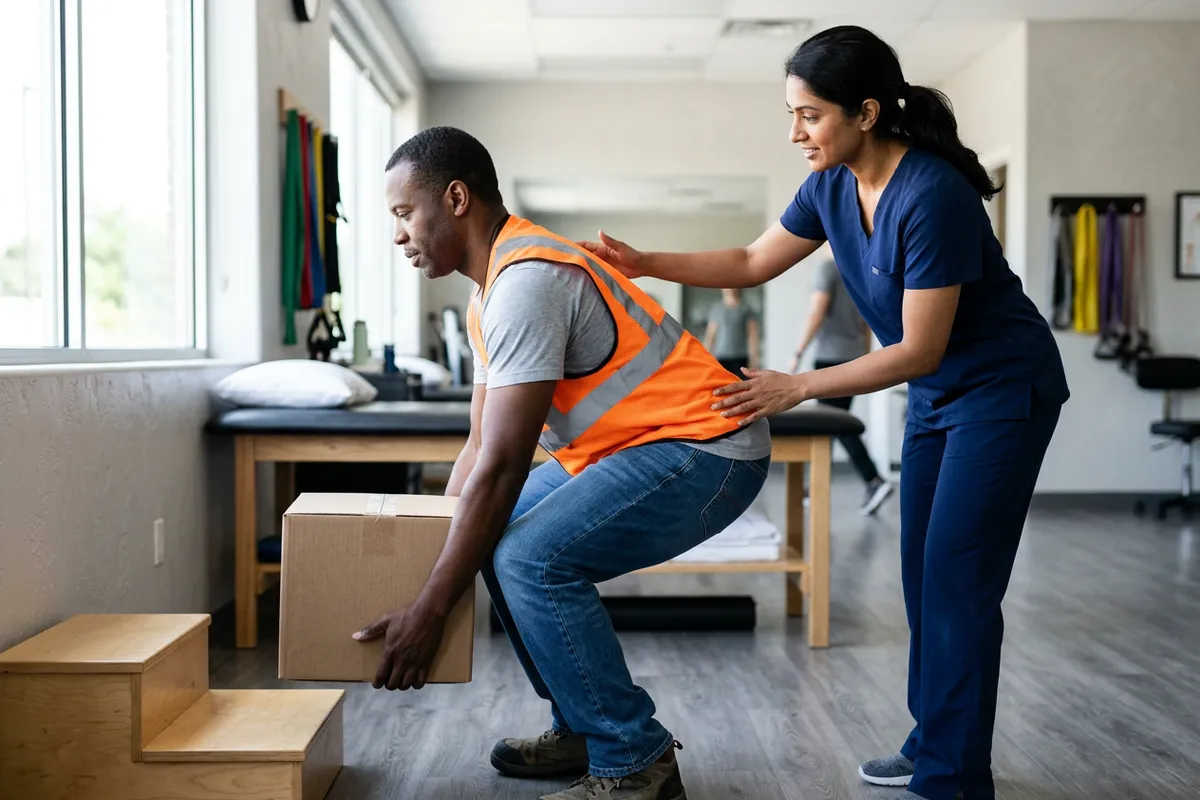
Whether you spend your shift at a laptop in Jersey City, on a loading dock in Kearny, or helping patients in and out of bed in the Bronx, work can wear on your body. The good news: most work-related aches respond well to smart changes and the right kind of movement.
Musculoskeletal disorders (MSDs), sometimes called "ergonomic injuries," include strains, sprains, back injuries, tendinitis, and nerve problems such as carpal tunnel syndrome. They are among the most common reasons people lose work time. In 2018, MSDs made up about 30 percent of private-sector injury and illness cases that required days away from work, and workers with an MSD needed a median of 12 days to recover before returning (BLS, 2020).
This guide covers what the research actually says about posture, how to set up a desk, how to handle heavy or awkward loads, why short breaks matter, and when it is time to see a physical therapist.
Who Gets Hurt at Work, and Why
MSDs are not just an office problem. The Bureau of Labor Statistics found that laborers and freight, stock, and material movers had the most MSD cases of any occupation in 2018, followed by nursing assistants and heavy and tractor-trailer truck drivers. MSDs made up more than half of all days-away-from-work cases among nursing assistants, and truck drivers with an MSD missed a median of 21 days (BLS, 2020).
OSHA's list of high-risk jobs reads like a snapshot of the North Jersey and New York City workforce: nurses and aides, warehouse stock clerks and order fillers, delivery and bus drivers, janitors and housekeepers, plumbers, HVAC technicians, maintenance workers, police officers, and firefighters (OSHA). The common risk factors are heavy lifting, bending, reaching overhead, pushing and pulling heavy loads, awkward postures, and doing the same motion over and over.
Posture Myths Worth Letting Go
Myth 1: There is one "correct" way to sit
Many of us grew up hearing "sit up straight." But a Journal of Orthopaedic & Sports Physical Therapy (JOSPT) viewpoint points out that there is no strong evidence that sitting, standing, or bending "incorrectly" causes spinal pain, even though a whole industry sells products to "fix" posture (Slater et al., JOSPT, 2019). Even OSHA's computer workstation guide says there is no single correct posture that fits everyone (OSHA eTool).
A more useful rule: your best posture is your next one. Holding any position for hours, even a "perfect" one, tires the same muscles. Changing positions often spreads the load around.
Myth 2: Rounding your back when you lift will injure it
A 2020 systematic review in JOSPT looked at whether bending the lower back while lifting predicts back pain. It found low-quality evidence that more lumbar flexion during lifting was not a risk factor for developing or keeping back pain (Saraceni et al., JOSPT, 2020). That does not mean technique never matters. It means fear of a rounded back should not stop you from moving, and that how much you lift, how often, and how fit you are for the task matter too.
Myth 3: A lifting class alone will protect your back
A Cochrane review of nine randomized trials with more than 20,000 workers found moderate-quality evidence that training in lifting technique, with or without assistive devices, did not by itself prevent back pain or back-related disability compared with no intervention (Verbeek et al., Cochrane, 2011). Prevention works better when the job itself is changed, which is the core idea of ergonomics: fitting the job to the person (OSHA).
Setting Up a Desk or Home Office
If you work at a computer, OSHA's design goals are a good starting checklist (OSHA eTool):
- Screen: top of the monitor at or just below eye level, so your head stays balanced over your shoulders. Laptop users may need a stand plus a separate keyboard and mouse.
- Arms: shoulders relaxed, elbows close to your body and supported.
- Hands: wrists in line with your forearms, with enough room for both keyboard and mouse.
- Back and feet: lower back supported by the chair, and feet flat on the floor or a footrest.
Adjustable furniture helps mainly because it makes changing positions easy. OSHA also suggests keyboard shortcuts in place of some mouse work, and keeping enough desk space to switch the mouse between hands now and then (OSHA eTool, Work Process).
Micro-Breaks: Small Pauses, Real Recovery
Computer work looks easy on the body, but a mouse hand can make thousands of small movements an hour, and holding your head toward a screen tires the neck and shoulders. OSHA recommends building short "micro-breaks" into computer sessions, such as a five-minute break from computer tasks every hour to look away, stretch, stand, or walk, and mixing non-computer tasks into the day (OSHA eTool, Work Process).
Physical jobs benefit from the same idea. Rotating between tasks, such as alternating heavy picking with lighter scanning or driving with loading, gives overworked muscles time to recover.
An easy micro-break: stand, reach both arms overhead, roll your shoulders, and take a short walk.
Lifting and Handling on Physical Jobs
Warehouse, logistics, and the trades
The best fix is usually to change the load or the setup, not just the worker. Use carts, dollies, hoists, and conveyors when they are available. Store heavy items between knee and shoulder height. Keep the load close to your body, test the weight before you commit, turn with your feet instead of twisting under load, and ask for a team lift when something is too heavy or awkward. Report early aches, too: OSHA notes that early reporting of symptoms can help stop them from turning into serious injuries and lost-time claims (OSHA).
Nurses, home health aides, and caregivers
According to NIOSH, the single greatest risk factor for work-related MSDs in healthcare workers is patient handling: manually lifting, moving, and repositioning patients. NIOSH recommends using assistive lifting devices, getting regular training on them, and following your employer's safe patient handling procedures (NIOSH, CDC). If you work in clients' homes, ask whether slide sheets, gait belts, or a mechanical lift can be added to the care plan.
Drivers
Long hours of sitting plus sudden lifting at a delivery is a tough combination. Adjust your seat so you can reach the pedals without stretching, use the lumbar support, and take a moment to move before you lift anything after a long drive.
How Physical Therapy Helps Workers
A physical therapist looks at both you and your job. Your evaluation includes strength, flexibility, and movement testing, plus questions about what your workday actually demands. From there, treatment may include:
- Graded exercise to build the strength and endurance your job needs, from carrying boxes to holding your arms up at a keyboard.
- Hands-on care and, at our Fair Lawn, Lyndhurst, and Caldwell clinics, dry needling when appropriate.
- Job-specific practice, such as rehearsing lifts, pushes, or patient transfers.
- Workstation and task advice you can take back to your desk, truck, or shift.
- Return-to-work planning, including a Functional Capacity Evaluation (FCE), offered at all of our adult clinics, when a doctor, employer, or insurer needs an objective measure of what you can safely do.
If hand or wrist symptoms, such as numbness from heavy keyboard use, are getting in the way of work tasks, occupational therapy may also help.
Workers' compensation, including federal FECA claims
Holsman treats workers' compensation cases at its clinics, including federal employee claims under the Federal Employees' Compensation Act (FECA). Workers' compensation claims have their own approval steps, so report your injury to your employer promptly; our staff can work with your case manager or claims examiner. Learn more in our guide to workers' compensation physical therapy in Newark or on our insurance page.
When to See a Physical Therapist
Consider an evaluation if:
- Pain, stiffness, or aching at work lasts more than a week or two, or keeps coming back.
- You are changing how you do your job, or avoiding tasks, because of pain.
- You notice tingling, aching, cramping, or weakness in your hands, arms, neck, or back, warning signs OSHA lists for computer-related MSDs (OSHA eTool, Work Process).
- You had a specific injury at work, such as a strain while lifting or a slip.
- You are returning to a physical job after surgery or time off.
For low back pain specifically, see our post on lower back pain relief.
When to See a Doctor Right Away
Get urgent medical care for any of these:
- A fall, crush, or impact injury with severe pain, a deformity, or inability to bear weight
- New numbness in the groin or inner thighs, or new trouble controlling your bladder or bowels
- Rapidly worsening weakness in an arm or leg
- Back or neck pain with fever, unexplained weight loss, or a history of cancer
- Chest pain or shortness of breath, which may not be a muscle problem at all: call 911
If you are hurt at work, also report the injury to your supervisor as soon as possible.
Getting Started at Holsman
You can schedule physical therapy, occupational therapy and speech therapy directly. Some insurance plans require a referral for coverage; our staff will verify your benefits.
We have 17 clinics across New Jersey and New York, including Newark, Kearny, Jersey City, and the Bronx. Call 1-855-465-7626 or contact us to book.
Frequently Asked Questions
What is the best sitting posture at work?
There is no single correct posture for everyone. Set up your desk so the top of the screen is at or just below eye level, your shoulders are relaxed, your wrists are straight, your lower back is supported, and your feet are flat. Then change positions often, because holding any posture for hours tires the same muscles.
Is it bad to round my back when I lift?
A 2020 systematic review in JOSPT found low-quality evidence that bending the lower back during lifting was not a risk factor for developing or keeping back pain. Keep the load close, test the weight, turn with your feet, and use carts, lifts, or a coworker for heavy or awkward items.
How often should I take breaks at a desk job?
OSHA suggests short micro-breaks during computer work, such as a five-minute break every hour to look away, stretch, stand, or walk, and mixing non-computer tasks into your day.
Does Holsman treat workers' compensation injuries?
Yes. Holsman treats workers' compensation cases at its clinics, including federal employee claims under FECA. Report your injury to your employer promptly; our staff can work with your case manager or claims examiner.
When should I see a physical therapist for work-related pain?
Consider an evaluation if pain lasts more than a week or two or keeps coming back, if you are avoiding tasks because of it, if you have tingling or weakness in your hands or arms, or if you were injured on the job or are returning to a physical job after surgery.
Do I need a referral for physical therapy?
You can schedule physical therapy, occupational therapy and speech therapy directly. Some insurance plans require a referral for coverage; our staff will verify your benefits.
Sources
- U.S. Bureau of Labor Statistics (BLS). Occupational injuries and illnesses resulting in musculoskeletal disorders (MSDs). 2020.
- Occupational Safety and Health Administration (OSHA). Ergonomics: Overview. Accessed November 2026.
- Occupational Safety and Health Administration (OSHA). Computer Workstations eTool. Accessed November 2026.
- Occupational Safety and Health Administration (OSHA). Computer Workstations eTool: Work Process and Recognition. Accessed November 2026.
- National Institute for Occupational Safety and Health (NIOSH), CDC. About Safe Patient Handling and Mobility. 2026.
- Slater D, Korakakis V, O'Sullivan P, Nolan D, O'Sullivan K. “Sit Up Straight”: Time to Re-evaluate. J Orthop Sports Phys Ther 49(8):562-564. 2019.
- Saraceni N, Kent P, Ng L, Campbell A, Straker L, O'Sullivan P. To Flex or Not to Flex? Is There a Relationship Between Lumbar Spine Flexion During Lifting and Low Back Pain? A Systematic Review With Meta-analysis. J Orthop Sports Phys Ther 50(3):121-130. 2020.
- Verbeek JH, Martimo KP, Karppinen J, Kuijer PPFM, Viikari-Juntura E, Takala EP. Manual material handling advice and assistive devices for preventing and treating back pain in workers. Cochrane Database of Systematic Reviews, CD005958. 2011.
This article is for general education and isn't a substitute for an evaluation by a licensed clinician.