What sciatica is (and what it isn’t)
Sciatica is not a diagnosis by itself. It is a name for pain, weakness, numbness or tingling in the leg caused by pressure on, or injury to, the sciatic nerve or the nerve roots that form it in your lower back (MedlinePlus). The real diagnosis is whatever is squeezing the nerve, such as a herniated disk or spinal stenosis (AAOS).
That is what sets sciatica apart from ordinary low back pain. With sciatica, the main problem travels down the leg, often past the knee and into the calf or the sole of the foot (MedlinePlus). If your pain stays mostly in your back, see our back pain treatment page instead.
Common signs of sciatica
- Pain that starts in the low back, buttock or hip and spreads into the leg or foot, usually on one side (ChoosePT) (MedlinePlus)
- Sharp, shooting, electric or burning pain, sometimes like a bad leg cramp (AAOS)
- “Pins and needles,” numbness or a weak feeling in the leg (AAOS)
- Pain that is worse when you cough, sneeze or sit (ChoosePT) (MedlinePlus)
- Trouble getting up from a chair, standing up straight or walking without a limp (ChoosePT)
- A foot that catches on the ground when you walk (MedlinePlus)
What causes sciatica?
Sciatica is most likely between the ages of 30 and 75 (AAOS). The most common causes are:
- Herniated (“slipped”) disk. A disk between the bones of the spine bulges or breaks open and presses on a nerve root. In people under 40, this is the usual cause (AAOS). Disk-related leg pain often flares with sneezing, coughing or laughing (MedlinePlus).
- Lumbar spinal stenosis. With age, disks shrink and bone spurs and thickened ligaments narrow the space for the nerves. It happens most often in adults over 60 (AAOS). Leg pain, numbness or weakness tends to build with standing and walking and eases when you sit or lean forward, like leaning on a shopping cart (AAOS). In older adults, bone spurs and arthritis are the usual cause of sciatica (AAOS).
- Piriformis syndrome. Less often, the piriformis muscle deep in the buttock presses on the sciatic nerve. It is uncommon, and pain often builds the longer you sit (MedlinePlus).
- Other causes. A slipped vertebra (spondylolisthesis), a pelvic injury or fracture and, rarely, a tumor can also press on the nerve (MedlinePlus). Sciatica can start suddenly after a fall, an awkward lift or a car accident (ChoosePT); see our car accident physical therapy page if that is how yours began.
When sciatica is an emergency
Rarely, a disk or stenosis squeezes the whole bundle of nerve roots at the bottom of the spine. This is called cauda equina syndrome, and it is a surgical emergency (AAOS). Go to the emergency room right away if you have back or leg pain with any of these:
- You can’t urinate, or you leak urine or stool without control (AAOS)
- Numbness or tingling between your legs, around the buttocks or in the inner thighs (“saddle” numbness) (AAOS)
- Severe or worsening weakness, numbness or tingling in your legs or feet (AAOS)
- A foot you suddenly can’t control, so you trip over it (MedlinePlus)
Call your doctor promptly for back pain with fever, pain after a hard fall or blow, pain that is worse lying down or wakes you at night, unexplained weight loss, or pain that is different and worse than before (MedlinePlus). Our free back and neck red-flag check walks through these warning signs.
How physical therapy helps sciatica
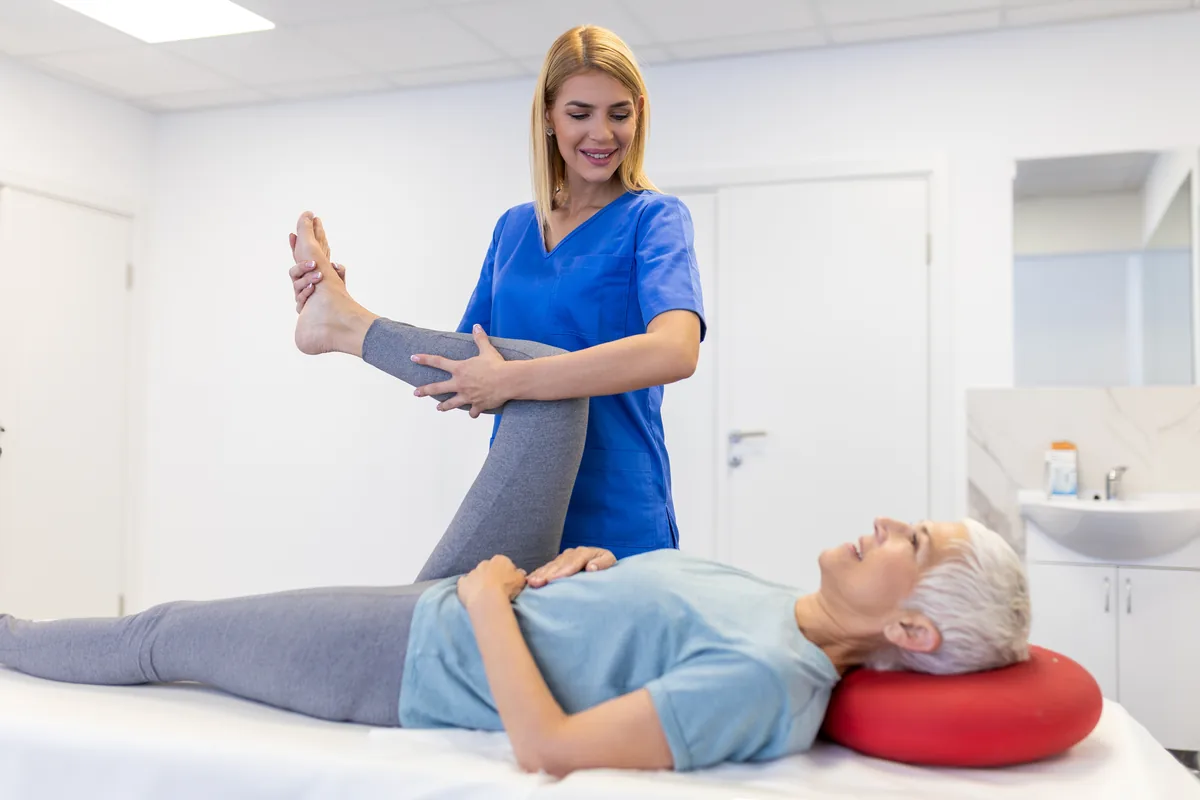
About 80% to 90% of people with sciatica get better over time without surgery (AAOS), and most respond well to physical therapy (ChoosePT). Your first visit is a full evaluation. Your therapist asks how the pain started and what makes it better or worse, checks your strength, feeling and reflexes, and looks at your posture and how you move and walk (ChoosePT). We may use the lumbar spine special tests, including the straight-leg raise (AAOS), and questionnaires such as the Roland-Morris and Patient-Specific Functional Scale to track your progress.
Most people do not need an X-ray or MRI to start. Tests are often not needed unless pain is severe or long-lasting (MedlinePlus), and guidelines advise against routine imaging (NICE guideline). If anything in your exam is a concern, we contact your doctor about further testing (ChoosePT).
Your plan is built around active care. It may include:
- Staying active, the right way. Bed rest is not recommended (MedlinePlus). We help you stay as active as you comfortably can, with short walks several times a day (ChoosePT), and show you how to keep up your normal activities and work (NICE guideline).
- Exercises that ease your leg symptoms. Your therapist looks for the movements and positions that reduce your leg pain and turns them into a home program (ChoosePT).
- Trunk and core strengthening. The APTA low back pain guideline supports exercise, including trunk strengthening, endurance and specific trunk muscle training, for back pain with leg pain, and movement-control exercise when the leg pain has lasted longer (APTA/JOSPT guideline). For older adults with long-lasting back pain, the guideline supports general exercise (APTA/JOSPT guideline).
- Nerve gliding (neural mobilization). Gentle movements that help the irritated nerve move more freely. Used with other treatments, they can give short-term relief for long-lasting back pain with leg pain (APTA/JOSPT guideline).
- Hands-on care with exercise. Joint mobilization or soft-tissue work can be part of your care, but only together with exercise (NICE guideline).
- Posture, sitting and lifting. We teach safer ways to sit, stand and lift so less pressure lands on the nerve (ChoosePT). See our workplace ergonomics and posture tips.
What we don’t rely on. Guidelines do not support mechanical traction for back pain with leg pain (APTA/JOSPT guideline) (NICE guideline), and they advise against back belts and corsets (NICE guideline). We focus on care you take part in.
Dry needling. The APTA guideline says dry needling can be considered along with other treatments for short-term relief of long-lasting low back pain, though the evidence is limited (APTA/JOSPT guideline). We offer dry needling at our Lyndhurst, Caldwell, Fair Lawn and Cedar Grove clinics. It is often not covered by insurance, and Medicare does not pay for it.
AlterG® anti-gravity treadmill (Fair Lawn). It takes part of your body weight off your legs so you can practice walking, and later jogging, earlier in recovery, as your therapist and surgeon allow. Ask about it at our Fair Lawn clinic.
Physical therapy for spinal stenosis
Stenosis needs a slightly different plan. Nonsurgical care does not widen the spinal canal, but many people get real relief (AAOS), and most cases can be managed with physical therapy and other conservative care (ChoosePT). Your therapist may teach positions and gentle movements that take pressure off the nerve, stretching and range-of-motion exercises, trunk, arm and leg strengthening, and aerobic exercise to help you walk farther (ChoosePT). Because walking can be more painful than sitting, a stationary bike is often an easier way to stay fit (ChoosePT) (AAOS). Some people also walk on a treadmill with a harness that takes part of their body weight to ease pressure on the nerves (ChoosePT).
Will I need surgery?
Most people don’t. Surgery is usually a last resort (MedlinePlus). It may be considered if disabling leg pain remains after 3 or more months of nonsurgical treatment (AAOS), or when nonsurgical treatment has not helped and imaging matches your symptoms (NICE guideline). If you do have surgery, physical therapy afterward helps you regain motion and strength (ChoosePT), and the APTA guideline supports general exercise after lumbar spine surgery (APTA/JOSPT guideline).
Clinic or in-home therapy?
- At a clinic: more equipment and room to practice walking and strengthening. Best if you can travel safely.
- At home: no driving or long car rides while sitting hurts. Our in-home therapy team visits many North Jersey towns.
Insurance and getting started
At our New Jersey clinics, we accept Medicare, Medicare Advantage plans including Clover Health and UnitedHealthcare Medicare Complete, commercial insurance, workers’ compensation, auto/no-fault, VA Community Care and private pay, and we verify your coverage for free before your first visit. See our insurance page for details.
Medicare Part B helps pay for medically necessary outpatient physical therapy. After the Part B deductible, you usually pay 20% of the Medicare-approved amount, and there is no yearly limit on medically necessary outpatient therapy (Medicare.gov).
In New Jersey you can start physical therapy without a prescription. Within 30 days of your first treatment, we send a written consult to the health care provider you choose. Some insurance plans still require a referral, and Medicare requires your plan of care to be signed by your doctor, nurse practitioner or physician assistant; we coordinate both and tell you what your plan needs. Rules differ in New York, so call us and we will explain what applies to you.
Most New Jersey patients are seen the same day or within 24 hours; our New York City clinics (Bronx, Bronx Morris Park and Brooklyn) and in-home therapy offer same-week appointments.
Related conditions we treat: back pain, neuropathy & nerve pain, knee pain and shoulder pain.
Find a clinic near you
We provide sciatica physical therapy at all 16 open Holsman clinics across Essex, Bergen, Passaic, Hudson and Union counties, the Bronx and Brooklyn, and with in-home therapy across North Jersey. (Our Clifton Route 3 clinic is temporarily closed.)
Related reading: Sciatica Relief: Causes and PT Treatment · Lower back pain relief · Physical therapy at Holsman