MS fatigue is not ordinary tiredness, and pushing through it rarely works. The right kind of exercise, done at the right dose, with smart pacing and cooling, can help many people with MS feel less drained. Here is what physical therapy for MS fatigue looks like and what the evidence says.
If you live with multiple sclerosis (MS), you probably know the difference between being tired and MS fatigue. The National MS Society’s fatigue guide calls fatigue the most common symptom of MS: as many as 75% to 95% of people with MS have it, and 50% to 60% say it is one of their worst problems (National MS Society). Fatigue can be physical, like heavy legs or arms, or cognitive, like slowed thinking and mental exhaustion (NINDS).
For the bigger picture on MS rehab (balance, walking and falls), see our guide to physical therapy for multiple sclerosis.
First, Rule Out Other Causes of Fatigue
Not every tired day is MS. Guidelines advise checking for other causes first, because many of them can be treated: sleep problems, pain, spasticity, bladder problems that wake you at night, medicine side effects, infections, anemia, thyroid problems, and anxiety or depression (NICE NG220, 2022). The National MS Society also lists heat and humidity, stress, and physical inactivity, which leaves the body deconditioned so that everyday tasks take more energy (National MS Society). Your doctor looks at the medical causes; your physical therapist looks at how you move and how your day is organized.
Can Physical Therapy Help MS Fatigue?
Yes, for many people. The U.S. National Institute of Neurological Disorders and Stroke (NINDS) notes that daily physical activity of mild to moderate intensity can significantly reduce MS fatigue, that people should avoid excessive activity and high temperatures, and that physical and occupational therapy can sometimes help manage fatigue: PT with personalized treatment, and OT by teaching ways to use energy wisely (NINDS).
The research supports this. A Cochrane review of 45 trials with 2,250 people with MS concluded that exercise therapy can be prescribed without harm and may reduce self-reported fatigue, especially endurance (aerobic) training, mixed training, and other forms such as yoga. Most of the people studied had relapsing-remitting MS and milder disability, and the overall quality of the evidence was moderate (Cochrane, 2015). A later network meta-analysis of 113 trials found moderate to large effects for exercise, with balance exercise showing the largest effect, and found strong evidence for cognitive behavioral therapy as well (Harrison et al., 2021).
The UK’s national MS guideline puts it simply: aerobic, resistance and balance exercise, including yoga and Pilates, may help MS-related fatigue. For people whose mobility is moderately affected, it suggests a supervised program of aerobic and moderate progressive resistance exercise combined with cognitive behavioral techniques (NICE NG220, 2022).
What a Physical Therapy Plan for MS Fatigue Includes
1. A careful evaluation
Your therapist tests strength, balance, walking and endurance, asks how fatigue changes through the day, and checks whether a brace or cane could make walking less tiring. The National MS Society guide describes exactly this kind of review, including an activity diary that shows which activities take the most out of you (National MS Society).
2. Aerobic (endurance) exercise
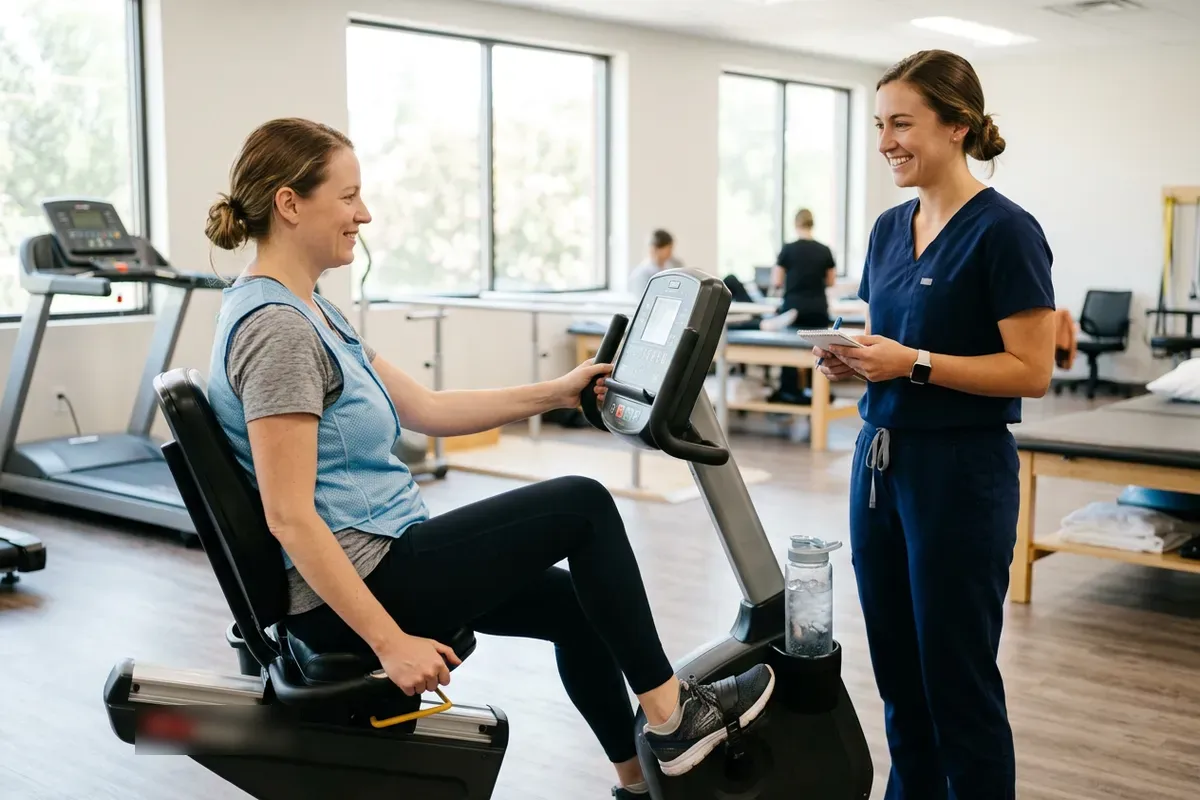
Walking, a recumbent bike or an arm bike, started at a level you can recover from and built up gradually. Endurance training is one of the types with the best evidence for reducing fatigue (Cochrane, 2015).
3. Resistance (strength) training
Stronger legs and hips make walking and stairs cost less energy. Guidelines pair moderate, progressive resistance work with aerobic exercise (NICE NG220, 2022).
4. Balance training
Balance work can steady your walking and, according to recent research, may also ease fatigue (Harrison et al., 2021).
5. Energy conservation and pacing
Often taught by an occupational therapist, energy-saving strategies help you spend energy on what matters most. The National MS Society suggests planning must-do tasks for your most energetic times, setting priorities and dropping low-priority tasks, and taking short rests or naps of 10 to 30 minutes if they don’t disturb your night’s sleep (National MS Society). For example, sit to prepare meals and spread heavy chores across the week.
6. Staying cool
Heat can temporarily make MS symptoms worse, and symptoms usually settle once you cool down (National MS Society). Your therapist can plan exercise in air conditioning or at cooler times of day and help you use cooling vests, neck wraps, cold drinks and a cool shower afterward (National MS Society).
Pacing: The Most Important Rule
More is not always better. The National MS Society warns that over-exercising can cancel out the benefits and worsen fatigue, and advises following the program you build with your therapist and checking back if it stops working (National MS Society). A good program should leave you feeling more capable over the following weeks, not wiped out for days. Practical pacing tips:
- Start with short bouts, such as 5 to 10 minutes, and add time slowly.
- Exercise at your best time of day, often the morning, and in a cool room.
- Use a 0 to 10 effort scale and stay in the light-to-moderate range as you build up.
- On a bad day, do a shorter, lighter session instead of stopping completely.
Exercise is safe for people with MS, and the National MS Society recommends starting with an evaluation by a therapist experienced in MS (National MS Society, 2020).
How We Measure Progress
We track fatigue with questionnaires such as the Modified Fatigue Impact Scale (National MS Society) and repeat tests such as the 6-Minute Walk Test and Timed 25-Foot Walk.
When to Call Your Neurologist or 911
Physical therapy works alongside your neurologist, who manages your MS and its medicines.
- Call your neurologist for new symptoms or a clear worsening of old ones lasting more than 24 hours, which may be a relapse (NICE NG220).
- Call your doctor if fatigue comes with a fever or signs of infection, such as burning with urination. Infections should be ruled out before a relapse is diagnosed (NICE NG220).
- Call your doctor if fatigue is sudden and severe, comes with shortness of breath or chest discomfort, or you feel low or hopeless most days.
- Call 911 for sudden face drooping, arm weakness or trouble speaking, a fall with a head injury, or trouble breathing.
MS Fatigue Care at Holsman
Our team includes two board-certified neurologic clinical specialists (NCS): Dr. Richard Holsman, PT, DPT, NCS, and Dr. Mandakini Desai, PT, DPT, NCS, clinic supervisor at our Maplewood and South Orange clinics. Our occupational therapists can help with energy conservation at home and at work. If getting to a clinic takes too much energy, ask about in-home therapy in Northern New Jersey.
You can schedule physical therapy, occupational therapy and speech therapy directly. Some insurance plans require a referral for coverage; our staff will verify your benefits for free. Call 1-855-465-7626 or use the form on this page.
Frequently Asked Questions
Can physical therapy help fatigue in multiple sclerosis?
Yes, for many people. NINDS notes that daily mild to moderate physical activity can significantly reduce MS fatigue, and a Cochrane review of 45 trials found exercise therapy may reduce self-reported fatigue without harm. A physical therapist builds a paced program of aerobic, strength and balance exercise and teaches strategies to save energy and stay cool.
What type of exercise is best for MS fatigue?
Aerobic, mixed and yoga-type programs had the best evidence in the Cochrane review, and a 2021 network meta-analysis found balance exercise had the largest effect. The best program is one matched to your symptoms that you can keep doing.
Will exercise make my MS fatigue worse?
It can if you do too much. The National MS Society warns that over-exercising can cancel the benefits and worsen fatigue. Start short and light, exercise in a cool place, and build up gradually with your therapist.
What is energy conservation for MS?
Energy conservation means planning your day so energy goes to what matters most: scheduling important tasks for your best time of day, setting priorities, sitting for tasks when you can, using helpful equipment, and taking short rests. Occupational therapists usually teach these strategies.
Do I need a referral to see a physical therapist for MS fatigue?
You can schedule physical therapy, occupational therapy and speech therapy directly. Some insurance plans require a referral for coverage; our staff will verify your benefits for free.
Sources
- National Institute of Neurological Disorders and Stroke (NIH). Multiple Sclerosis (MS). Last reviewed December 17, 2025. Accessed November 2026.
- National Multiple Sclerosis Society. Fatigue: What You Should Know – A Guide for People with MS (consumer guide to the MS Council for Clinical Practice Guidelines fatigue guideline; 2019 edition). Accessed November 2026.
- Heine M, van de Port I, Rietberg MB, van Wegen EE, Kwakkel G. Exercise therapy for fatigue in multiple sclerosis. Cochrane Database of Systematic Reviews. 2015;(9):CD009956. doi:10.1002/14651858.CD009956.pub2. Accessed November 2026.
- Harrison AM, Safari R, Mercer T, et al. Which exercise and behavioural interventions show most promise for treating fatigue in multiple sclerosis? A network meta-analysis. Multiple Sclerosis Journal. 2021;27(11):1657–1678. doi:10.1177/1352458521996002. Accessed November 2026.
- National Institute for Health and Care Excellence (NICE). Multiple sclerosis in adults: management (NG220), Recommendations 1.5.3–1.5.23. Published 2022, last updated 2026. Accessed November 2026.
- Kalb R, Brown TR, Coote S, et al. Exercise and lifestyle physical activity recommendations for people with multiple sclerosis throughout the disease course. Multiple Sclerosis Journal. 2020;26(12):1459–1469 (National MS Society). Accessed November 2026.
- National Multiple Sclerosis Society. Heat & Temperature Sensitivity. Accessed November 2026.
This article is for general education and isn't a substitute for an evaluation by a licensed clinician.